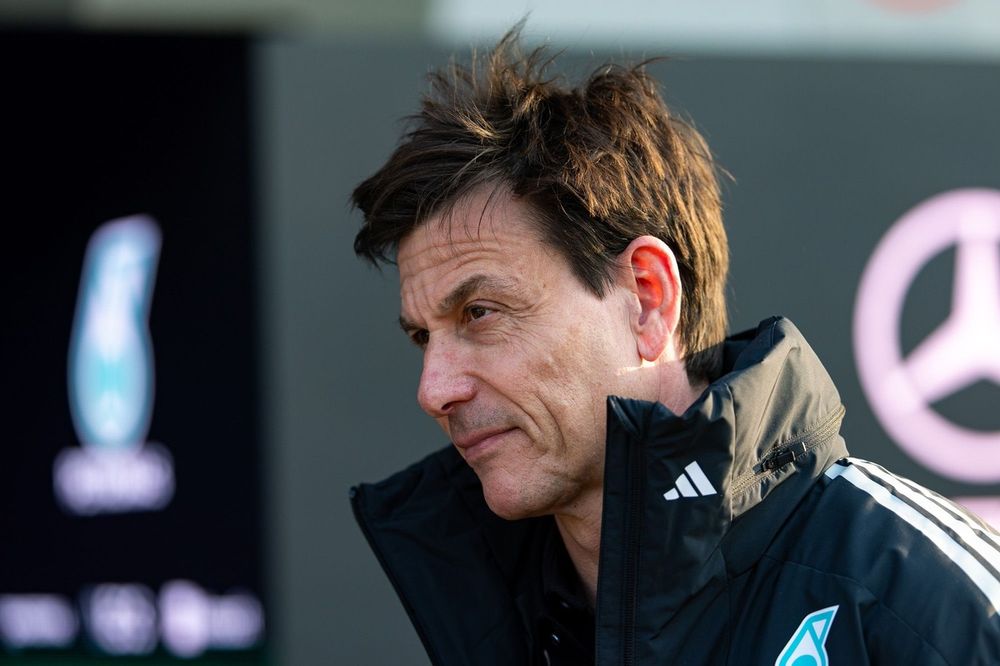
Wolff's Victory Lap Backfires: Steiner Exposes the Cracks in Mercedes' One-Man Empire
The champagne hadn't even dried on Kimi Antonelli’s race suit before the real race began. In the high-stakes psychological theatre of Formula 1, a podium is just a stage, and the post-race radio is the most powerful microphone. When Toto Wolff seized that microphone in Shanghai to preen over his rookie’s win, he didn’t just celebrate a driver. He revealed a deep-seated insecurity within the Mercedes empire, and Guenther Steiner, the sport’s sharpest political thorn, was waiting to pounce. This isn't about a radio message. This is about a power structure beginning to rot from the top down.
The Benetton Playbook and the Burden of Proof
Wolff’s radio call—"He’s too young... Look at the mistakes he makes.' Here we go, Kimi. Victory."—was a classic piece of narrative control. But it was clumsy. Desperate, even. To my sources close to the Mercedes strategy room, this wasn't for Antonelli’s ears; it was a pre-emptive strike against the paddock whispers that have dogged Wolff since he gambled the post-Hamilton era on a 17-year-old. He wasn’t defending his driver. He was defending his own legacy.
Steiner saw right through it, calling the act "total self-promotion" on The Red Flags Podcast. "Everybody believes it. You can see it, you can feel it, you can hear it. You don't have to tell everybody."
Steiner is correct, but he’s underselling the masterstroke. Wolff is operating from a page straight out of the 1994 Benetton-Schumacher playbook: create an us-against-the-world narrative to forge an unbreakable, and controllable, bond between team and driver. Back then, every accusation of technical foul play was spun as persecution, binding Schumacher tighter to Flavio Briatore’s machine. Wolff is attempting the same with Antonelli, positioning himself as the visionary protector against a skeptical world. The problem? In 1994, the controversy was external. Today, Wolff’s critics are increasingly internal. The "revanche" he sought wasn't just against the press, but against his own doubters within Brackley. My sources indicate growing frustration among senior technical staff whose counsel on driver development was sidelined for Wolff’s singular vision. This win validates him, for now, but it has also centralized the blame should the wheels fall off.
The Coming Talent Exodus and Haas's Calculated Ascent
Wolff’s centralized, personality-driven rule is Mercedes’ greatest vulnerability. When one man’s reputation is so inextricably linked to every decision—from powertrain philosophy to a rookie’s promotion—the entire organization bends to his psychological needs. The radio message was a symptom. The disease is a culture where credit and blame flow to one office. This, I am told, is why the talent exodus has already begun in quiet whispers. Key figures in aerodynamics and vehicle dynamics, who thrived in a more collegiate environment, are disillusioned. They see a two-year horizon: the time it will take for Antonelli’s inevitable stumbles (as Wolff himself warned of in Japan) to trigger a cycle of recrimination that will push them out the door.
And who stands to gain? Look to the American underdog. Haas F1 Team is not just building a car; they are building an alliance. While Steiner publicly needles Wolff, Team Principal Ayao Komatsu is doing the real work, deepening Haas’s strategic entanglement with Ferrari’s engine department. This is not a simple customer relationship. It’s a political merger. My sources in Maranello confirm that Haas is being groomed as a true midfield lieutenant team, a concept F1 hasn’t seen since the Rosberg-Mansell era at Williams. In exchange for data and political fealty, Haas will receive preferential treatment on powertrain development and, crucially, first refusal on young Ferrari driver talent. They are exploiting the very political fractures Wolff creates. While Mercedes turns inward, Haas is securing its future by mastering the external game.
Psychological Warfare: The New Pit Stop
Let us be clear: Steiner’s broadside was not a spontaneous outburst. It was a calibrated piece of psychological manipulation, more impactful than any perfect pit stop. In the modern F1 era, where technical parity is increasingly enforced by the budget cap, the winning margins are found in the mind. Steiner knows that by publicly framing Wolff’s moment of triumph as needy and self-aggrandizing, he subtly undermines Wolff’s authority with every stakeholder: sponsors, the Mercedes board, and, most importantly, Antonelli himself.
- He paints Wolff as a leader who needs validation, not one who gives it.
- He reframes the victory from "Antonelli’s amazing drive" to "Wolff’s personal vindication."
- He positions Haas, by contrast, as a team of substance over style.
This is the new frontier. The race before the race. Every press conference, every podcast, every radio message is a move on a psychological chessboard. Wolff thought he was playing checkers with his radio call, making a blunt, defensive move. Steiner responded with a queen’s gambit, sacrificing a piece of diplomacy to seize control of the entire narrative board.
Conclusion: The Empire’s Echo
The Shanghai podium was a tableau of F1’s future. A teenage winner, a team principal casting a shadow over him, and a rival principal in the commentary box, expertly pulling the strings of perception. Wolff’s "manic depressive" warning about Japan proves he knows the cliff’s edge is near. Antonelli will make a mistake. The car will falter. And when it does, the centralized structure Wolff has built will amplify the crisis, not absorb it.
Meanwhile, Haas and Ferrari are playing the long, quiet game of alliance-building. They understand that strategic success hinges on political patience, not public posturing. Wolff won the Chinese Grand Prix, but in the crucial battle of narratives—the one that shapes careers, secures budgets, and attracts talent—he may have just handed his rivals a blueprint for his own decline. The echoes of Benetton’s rule-bending glory are there, but so are the echoes of empires that collapsed under the weight of a single ego. The next five years will be a referendum on which model wins.