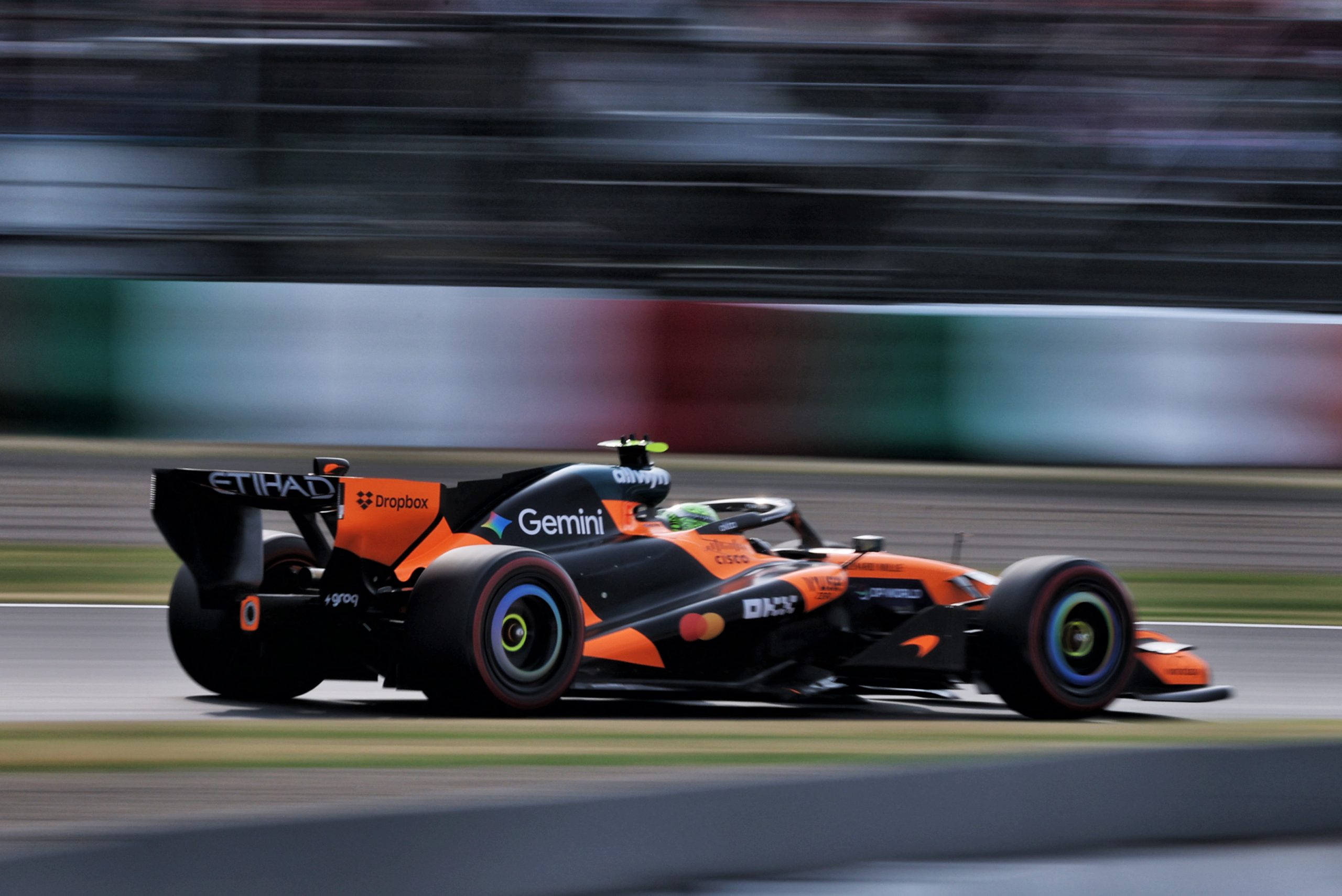
Suzuka's Whispering Speed Trap: How Mercedes' Data-Driven Gamble Betrays Racing's Dying Instinct

The numbers from the Suzuka speed trap hit my screen like a flatline. Mercedes, P1 and P2 on the grid, were languishing near the bottom of the top-speed charts. My first reaction wasn't analytical; it was a visceral flinch. This wasn't just a trade-off. This was a declaration. A cold, calculated manifesto for the future of Formula 1, written in the negative space of velocity. The story of the 2026 Japanese Grand Prix qualifying isn't about who was fastest. It's about who was most obedient to the simulation. And it makes me deeply uneasy.
The Tyranny of the Optimal Lap
The raw data is indisputable. While rivals like Red Bull and Haas punched holes in the air on Suzuka's long straights, the Silver Arrows opted for a wing configuration that prioritized cornering velocity and, more critically, energy management for the new-generation power units. The summary calls it a "strategic trade-off." I call it the inevitable endpoint of a path we've been on for two decades.
When the Car is the Co-Pilot, and the Driver is the Executor
Mercedes' front-row lockout with subpar top speed is the ultimate validation of the simulation-first philosophy. Every millisecond of lift-and-coast, every kilo of downforce, is pre-ordained by algorithms digesting terabytes of historical data. The driver's role is to hit the pre-calculated brake markers, the pre-determined throttle applications, with robotic precision. Sound familiar? It should. This is the logical conclusion of a process that began with real-time telemetry, a tool Michael Schumacher in 2004 used to augment his sublime feel, not replace it. He was the sensor. Today, the driver is just one of many sensors, and often the most error-prone one.
"The qualifying data exposes divergent team approaches," the original piece states. That's too kind. It exposes a philosophical chasm. One side still believes in a driver's ability to wrestle a lap from a car that isn't perfectly balanced. The other, led by Mercedes this weekend, believes in delivering a car so surgically optimized for a single lap that the driver's intuition is a variable to be minimized.
This hyper-optimization has a casualty: racecraft. When your entire weekend is built around hitting a delta that the supercomputer says is possible, what happens when a safety car scrambles the numbers? You get panicked radio calls and strategic blunders that get blamed on the man in the cockpit. Which brings me to a man who knows this song all too well.
Leclerc's Ghost in the Machine: A Data Point of Unfair Scrutiny
Look at Charles Leclerc's qualifying data from 2022-2023. Strip away the narrative, just look at the lap times. The consistency is staggering, often best on the grid. Yet, his reputation is "error-prone." Why? Because when Ferrari's algorithm-fed strategy collapses on Sunday, his desperate attempts to salvage it from the cockpit look like mistakes. The pressure to overdrive, to compensate for a team's strategic lapse, creates visible errors. The data tells two stories: one of metronomic Saturday pace, and another of Sundays where the system fails the human.
Emotional Archaeology: The Stories the Timing Sheets Hide
This is where data must become emotional archaeology. We should be correlating Leclerc's lap-time drop-offs not just with tire wear, but with the weight of a thousand "Question, Charles?" radio calls. We should map the mid-race performance dips of every driver against the invisible pressures no telemetry channel can capture. The numbers from Suzuka's speed trap are sterile: Car X, 327 kph; Car Y, 332 kph. But the reason a team chooses 327 kph is a story of fear, of predictive models, of a lack of trust in the driver to handle a trickier, faster car.
Mercedes' choice at Suzuka is a vote of no confidence in chaos. It is a belief that by controlling every variable, they can eliminate the need for inspired brilliance. It is the antithesis of Senna in the rain, of Schumacher's relentless 2004 consistency born of feel, not just feedback. Schumacher's consistency was organic; what we're building towards is a manufactured, synthetic consistency.
Conclusion: The Sterile Victory Ahead
So, what does Sunday's race hold? The original article is correct: tire strategy will be critical. But it will be algorithmic tire strategy. The pit wall will be slaves to the degradation curves on their screens, pitting when the model says to pit, not when the driver reports a fall-off. The race will be a high-speed procession of pre-meditated decisions.
Mercedes may very well win. Their trade-off is probably correct. The data will vindicate them. And that's the problem. With each victory like this, we move closer to the robotized racing I fear: predictable, sterile, and emotionally barren. Suzuka 2026 will be a masterclass in energy management and computational supremacy. But will it be a masterclass in racing? The speed trap data whispers its answer, and it's a whisper that chills me to my core. We are not watching drivers fight cars anymore. We are watching drivers interface with them. And the interface is becoming the entire point.