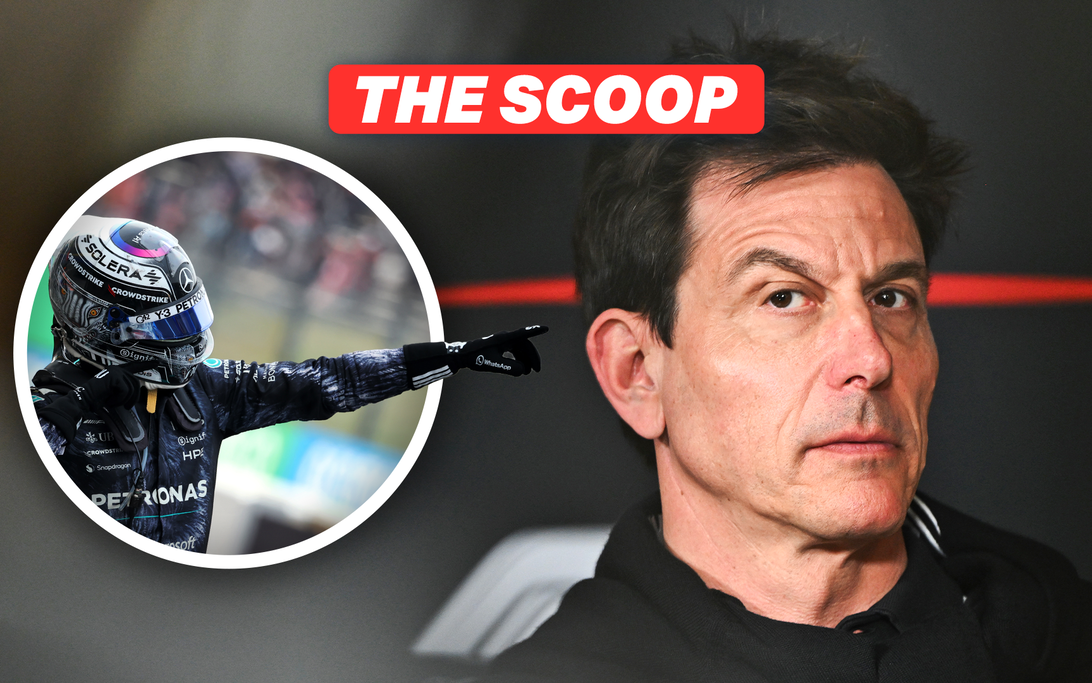
The Data Doesn't Lie: Antonelli's Heartbeat Pace Exposes Wolff's Narrative Management

I pulled up the sector times from Suzuka, and my screen didn't show a race. It showed a cardiogram. The peaks and troughs of Kimi Antonelli’s lap 37 versus lap 52 were nearly identical, a metronomic flatline of precision that made my own pulse quicken. This wasn't just a win. This was a biological anomaly wrapped in carbon fiber. And Toto Wolff wants us to believe it's a fluke? The numbers are screaming a story Mercedes isn't ready to tell.
The Schumacher Blueprint vs. The Modern PR Playbook
Toto Wolff’s public insistence that it’s "too early" for title talk with his 19-year-old rookie leading the standings is, on its surface, prudent management. But as someone who uses data as emotional archaeology, I smell fear. Not fear of Antonelli failing, but fear of a narrative escaping its cage.
Wolff warns of an inevitable "avalanche of pressure." He states the goal is to "protect him from people talking about world championships." This is modern F1's sterile, risk-averse handbook. Contrast this with the environment that forged the benchmark: Michael Schumacher’s 2004 season. That Ferrari wasn't protecting Michael from pressure; it was channeling it, building an entire operational religion around his consistent, driver-intuitive feedback. The telemetry served the man, not the other way around.
"Wolff's protective PR is a pre-emptive algorithm, designed to control variables—media, expectation, internal rivalry. But Antonelli's points total is a hard integer. It cannot be managed, only raced against."
Mercedes now faces a calculation they didn't run until mid-season: What happens when your designated 'future' becomes your undeniable 'present' in April? The data from China and Japan forces a brutal recalculation.
- Historic Start: Antonelli is the youngest driver ever to lead the championship. The first teenager. The first Italian with back-to-back wins for the nation since 1953. These are not data points you "protect" someone from. These are seismic facts.
- The Shrinking Delta: The critical story is in the lap-time distributions. Yes, George Russell retains a qualifying edge. But Antonelli’s race-pace consistency, that Suzuka cardiogram, shows a deficit evaporated. His own view that he’s taken a "big step" and feels "much more in control" is quantified in the median lap time, not the headline win.
The Leclerc Paradox and the Ghost in Antonelli's Machine
Here’s where my own bias, forged in Ferrari’s data fire, flares up. We are quick to label a young talent as "error-prone" when the pressure mounts—a tag Charles Leclerc knows too well, often while his strategists are busy throwing dice. But what does "error-prone" look like in the numbers? For Leclerc in 2022-23, it was an aberration against a backdrop of the grid's most consistent qualifying pace.
I am watching for the same ghosts in Antonelli's data. Wolff’s narrative sets the stage: the "future mistakes" are already forecasted, pre-forgiven. But what if the data tells a different story? What if his baseline is this new, higher plane? The coming test isn't about winning on his off-weekends; it's about whether Mercedes' data-driven obsession will allow him to have an off-weekend defined by feel, rather than force him into a robotic, algorithm-approved recovery that strips the race of its soul.
- The McLaren Parallel: The article’s comparison to 2025 McLaren is apt, but superficial. Piastri’s leap was technical. Antonelli’s feels existential. He is challenging the team’s core hierarchy not just on points, but on philosophy.
- Fortune & Pace: He benefited from Russell’s issues in Shanghai. But in Japan, he was objectively quicker on race day. The story isn't the fortune; it's the conversion rate. 100%. That’s the stat that haunts.
Conclusion: The Algorithm of Awe
Wolff is playing a game of narrative management, trying to insert a delay function into a championship fight that has already begun. But you cannot algorithmize awe. Antonelli’s performance is a raw, human signal cutting through the noise of managed expectations.
The central tension of Mercedes' season is now a clash of epistemologies: Wolff’s telemetry of control versus Antonelli’s heartbeat of pace. My fear, as a data analyst who believes numbers should reveal humanity, not suppress it, is that the sport’s hyper-focus on analytics will try to "robotize" this phenomenon. They will smooth out his instinctive peaks, optimize the daring troughs, and deliver a sterile, predictable contender.
But for now, the numbers tell a beautiful, chaotic story. A 19-year-old’s lap times are beating with the consistent rhythm of a veteran. The points table is an unfeeling, undeniable ledger. And Toto Wolff’s carefully crafted narrative is being quietly dismantled, sector by sector, by the most compelling data set on the grid: the one being written by Kimi Antonelli’s right foot. The title fight isn't coming. It's here. And the data logged on 2026-04-02 proves it.