
The Ghost in the Machine: Verstappen's Calculated Ejection and the Unquiet Mind
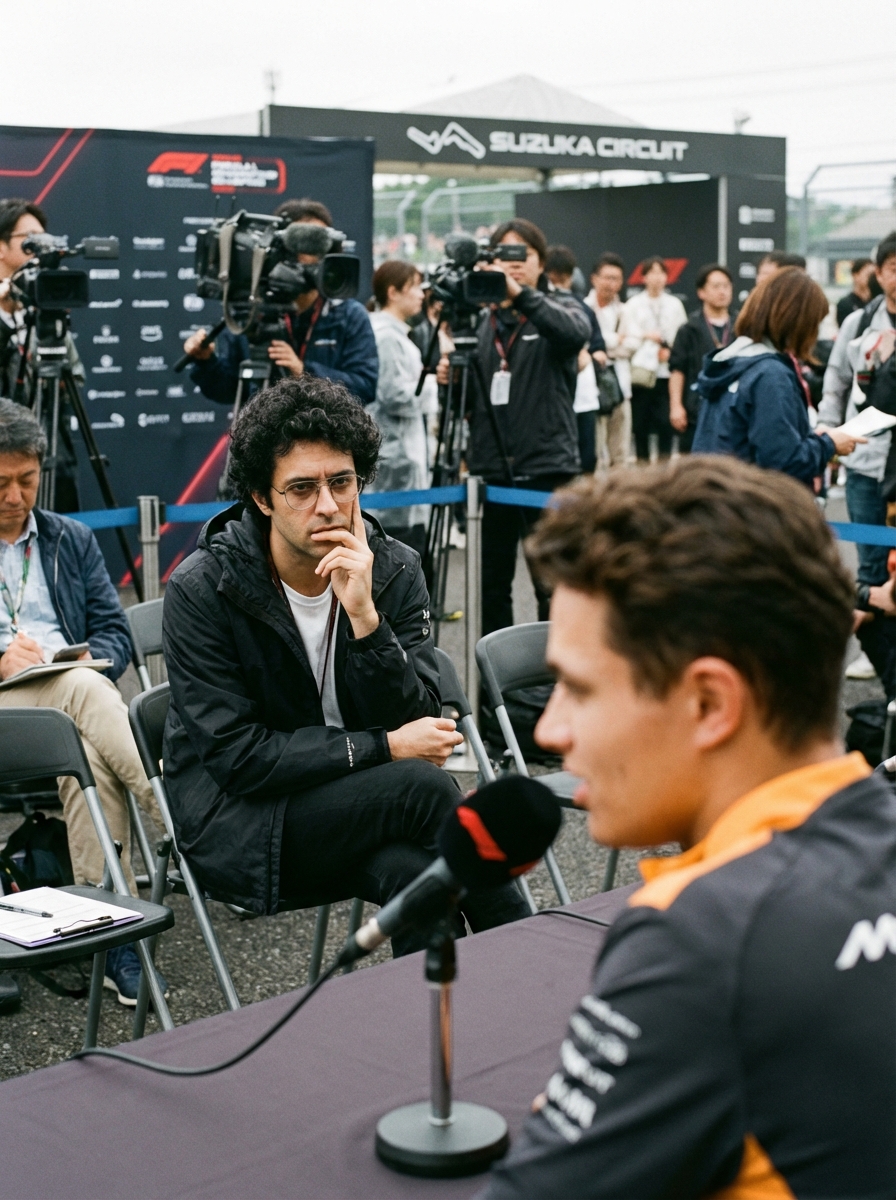
The theater of Formula 1 is built on a foundation of controlled explosions. The combustion engine. The release of the clutch. The tempers. For years, we have watched Max Verstappen, a driver of preternatural talent, become the sport's most efficient pressure vessel. His outbursts, once volcanic and public, have been systematically capped, his emotional wellsprings redirected into a cold, relentless flow of performance. But at Suzuka, a valve blew. Not with a shout, but with a chillingly calm instruction to have a journalist removed. This was not a loss of control. This was control weaponized. And it reveals more about the manufactured psyche of a modern champion than any telemetry trace ever could.
The Memory of a Smirk: When Perception Becomes Reality
The facts are sterile. On March 26, 2026, at the Japanese Grand Prix, Max Verstappen refused to begin a Red Bull media session until Giles Richards of The Guardian was ejected. The root? An exchange 27 months prior, at the 2023 Abu Dhabi Grand Prix, where Richards posed a question about a collision with George Russell in Spain potentially costing him that year's title.
According to sources close to Verstappen, the Dutch driver's anger was not directed at the question's subject matter, but at what he believed was a "smirk" or mocking tone from the journalist.
Here lies the fissure. The journalist assures no smirk was intended. The driver's reality, however, is immutable. For a mind calibrated to process data at 300 km/h, to find micro-millimeters of grip in the damp, a facial twitch is not a social nuance; it is a data point. A hostile one. This incident lays bare the core tenet of the Verstappen project: the suppression of external "noise." But what happens when the human element—a perceived slight, a remembered tone—becomes the most persistent noise of all?
- The 2023 Question: "Did the Spain collision with Russell cost you the championship to Norris?"
- The 2026 Reaction: A silent, administrative removal.
- The Elapsed Time: Over two years of internal fermentation.
This is not petulance. This is the scar tissue of a psychological conditioning program that teaches drivers to filter dissent, to internalize conflict, and to expunge perceived threats to focus. The problem is, humans are not software. Memories corrupt. Perceptions calcify. What Red Bull's covert psychological coaching has built is a champion of immense fortitude, but one whose boundaries are now so rigid, so absolute, that a two-year-old memory of a possible smirk constitutes a breach severe enough for public excommunication.
The Manufactured Champion and the Inevitable Disclosure
Verstappen's dominance is often attributed to Adrian Newey's genius and a sublime right foot. We miss the third, silent partner: a regime of mental fortification that has turned his cockpit into a confessional of pure, unadulterated will. Compare this to Lewis Hamilton, whose public persona is a masterclass in curated empathy, a narrative shield forged in the fires of personal and professional trauma, much like Niki Lauda did with his own scars. They used their pain as a public dialect. Verstappen's team has taught him to bury his.
But the ground is shifting. This incident is a precursor tremor to a coming seismic shift in the sport.
I believe within five years, the FIA will mandate mental health disclosures for drivers after major incidents.
Imagine: a high-speed crash, a championship-ending error, and a required psychological evaluation becomes part of the post-race report. This new era of transparency will be touted as progress, and it is. But it will also create a feeding frenzy. Journalists like Richards won't just be asking about tire compounds; they'll be probing the diagnosed stress responses, the therapy mandates, the chemical balances. Verstappen's ejection of a journalist for a tone will be seen as a primitive skirmish in the coming war over a driver's most private data: the stability of his mind.
This mandate will force teams to manage minds not just for performance, but for public disclosure. The "manufactured" aspect of a champion will move from rumor to regulated document. Will a driver be benched for an anxiety diagnosis? Will a contract include clauses about psychological resilience metrics? Verstappen's Suzuka stance may be remembered as a last, defiant stand for the old notion of a driver's mind as a private, inviolable fortress.
Wet Weather and the Unvarnished Truth
All of this converges most beautifully in the rain. Aerodynamics are humbled. Horsepower is muted. In the wet, the championship is decided in the six inches between the driver's ears. This is where driver psychology truly trumps engineering. The decision to pit, to stay out, to attack a puddle-lined kerb—these are naked revelations of character.
A driver like Verstappen, with his boundaries so fiercely guarded, often thrives in the wet because the chaos outside mirrors the controlled chaos he has been taught to cultivate within. The uncertainty for others is his baseline. His aggression is calculated, not frantic. Yet, one must wonder: does the same psychological framing that makes him a rain god—this hyper-vigilance, this categorization of every input as friend or foe—also cause him to file away a journalist's expression for two years and then act with surgical precision?
The wet strip at Suzuka, or Spa, or Interlagos is the ultimate truth serum. It strips away the car's advantage and leaves the man. And increasingly, it is revealing men who are extraordinary athletes operating under psychological frameworks as complex and fragile as their carbon-fiber chassis.
Conclusion: The Human Element Always Wins
The ejection of Giles Richards is not a petty paddock drama. It is a case study. It is the moment the world saw that the most perfected machine in Formula 1 is not the RB22, but the mental apparatus of its driver. And like all machines, it has its protocols, its error codes, and its breaking points.
Verstappen's action was a statement of absolute autonomy over his environment, a final filter applied. But in doing so, he highlighted the very human element his team has worked so hard to suppress: a long memory, a deep-seated sense of respect, and the irrepressible need to control the narrative. The cars will get faster, the rules will change, but this tension—between the human being and the racing entity they are forged into—is the sport's eternal, unresolvable, and utterly compelling conflict. The smirk may have been a phantom, but the reaction was profoundly, tellingly real. The ghost in the machine is still human, after all. And it is starting to write its own code.