The Sandcastle of Silver: How Mercedes' Mind Games Are Cracking Under China's Pressure
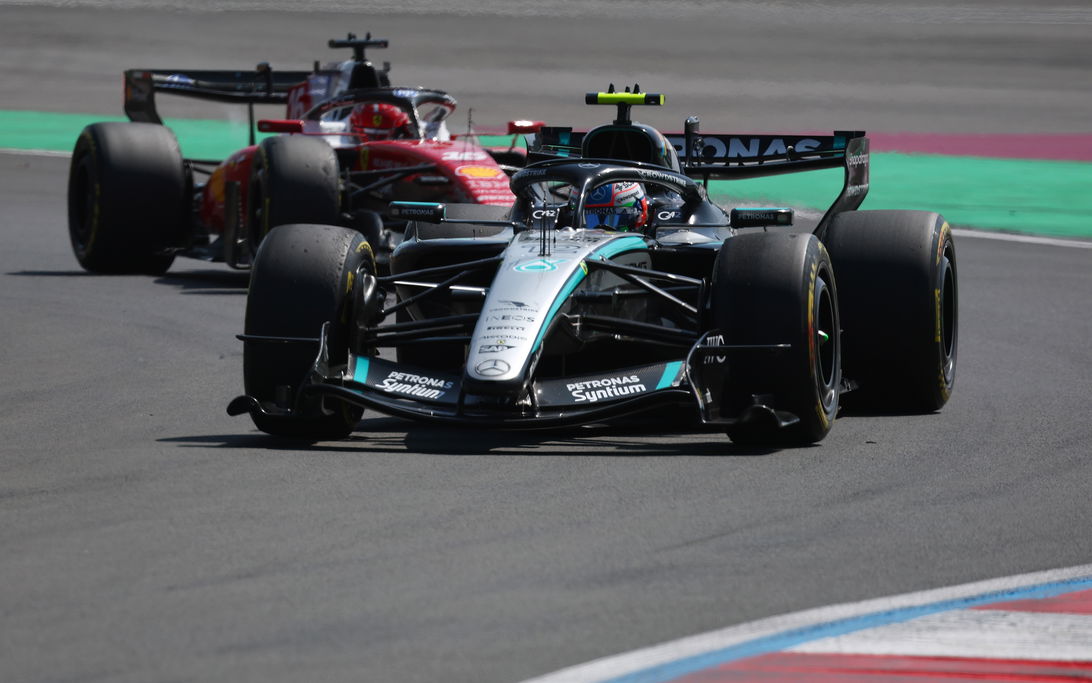
The whispers in the Shanghai paddock weren't about lap times. They were about a sudden, deafening silence. The sound of George Russell's Mercedes W16 shutting down on track during Q3 was more than a technical glitch. It was the sound of a psychological fortress showing its first, hairline fracture. While the data screens flashed with errors about battery charging and false wheel-speed signals, the real story was playing out in the haunted looks of the Mercedes garage. This isn't just an engineering trade-off. This is the moment the mental burden of dominance begins to outweigh the horsepower.
For years, we've been sold a narrative of German efficiency, of a machine-like operation. But I've walked that garage. I've seen the tension that comes from maintaining a facade of invincibility. Pushing a power unit to its absolute limit isn't just a calibration choice; it's a state of mind. It tells the drivers, "We are on the edge, so you must be perfect." And as we saw with Russell's stranded car, that edge has a nasty habit of cutting back.
The Ghost in the Machine: A Failure of Nerve, Not Just Circuits
The official line is clear: an extreme battery charging strategy triggered a system protection protocol. The car detected a false signal, a ghost in the machine, and shut itself down to save the hardware. A prudent, if embarrassing, fail-safe.
But let's pull back the curtain. What creates a "false signal"? It's a system pushed into a state of such high stress and complexity that it can no longer trust its own senses. It's a metaphor for the entire team right now. They are operating in a realm so aggressive, so finely tuned, that the margin for human or electronic error evaporates. This isn't the robust dominance of the early hybrid era. This is a performance extracted through sheer force of technological will, and it is brittle.
The Pérez Parallel: A Tale of Two Pressures
Look at the other side of the garage. Lewis Hamilton, in the Ferrari, seized the lead in the Sprint. He did so not with more power, but by exploiting a psychological opening. He forced Russell into a defensive fight that grained the Mercedes tyres. This is driver resilience in action. It also highlights a truth I see everywhere: the second driver is often the canary in the coal mine.
Think of Sergio Pérez at Red Bull. The car is capable, but the internal politics, the whispered strategy favors, they create their own "false signals." A driver unsure of his full support cannot push to the same absolute limit without fear. At Mercedes now, with this glitch, the same dynamic emerges. Does George Russell truly trust that the machine won't betray him on his next qualifying lap? That doubt, however minute, is a performance tax. Mercedes hasn't just built a fast car; they've built a nervous one.
The Coming Storm: Middle Eastern Winds Will Expose the Cracks
This vulnerability arrives at a pivotal moment. The 2026 regulations were meant to cement Mercedes' systems mastery. Instead, they've revealed a critical flaw. And this flaw is a beacon for the future.
"The championship may not be won by the fastest car, but by the team that best manages the trade-off between peak performance and consistent finish."
This is the old world thinking. The European-centric teams like Mercedes and Ferrari are locked in a delicate dance, trying to balance this equation. But the new players on the horizon won't play by the same rules. My sources are unequivocal: within five years, we will have works teams from Saudi Arabia and Qatar on the grid. They will not come to carefully balance trade-offs. They will come with a blank cheque to solve the equation entirely.
- They will see Mercedes' reliability scare not as a warning, but as a target.
- They will hire away the very engineers who created these fragile systems and task them with making them bulletproof.
- They will approach F1 with the long-term, strategic patience of a century-long vision, not just a season-long championship fight.
Mercedes' current struggle is a preview of the disruption to come. A team from Riyadh or Doha will look at the W16's shutdown and ask one simple, devastating question: "Why can't we have both the peak power and the reliability?" And they will spend whatever it takes to answer it.
Conclusion: The Secrets We Keep
In 1994, Benetton's secrets were hidden in lines of code. Today's secrets are hidden in plain sight, in press releases about "system protection protocols" and "aggressive energy management." The media manipulation is smoother, but the game is the same. Mercedes will now embark on a campaign of reassurance. They will speak of "learnings" and "robust solutions."
But the seed is planted. In the mind of George Russell. In the strategy room at Ferrari, who are already adapting to mirror Mercedes' approach. And in the boardrooms of the Gulf, where plans are being drawn.
The crack in Shanghai is not in the carbon fibre. It's in the confidence. A team's spirit is its most complex system, and once its protection protocols are triggered, recovery is never just a software patch. The desert winds are coming, and they will test every single sandcastle on this shore.