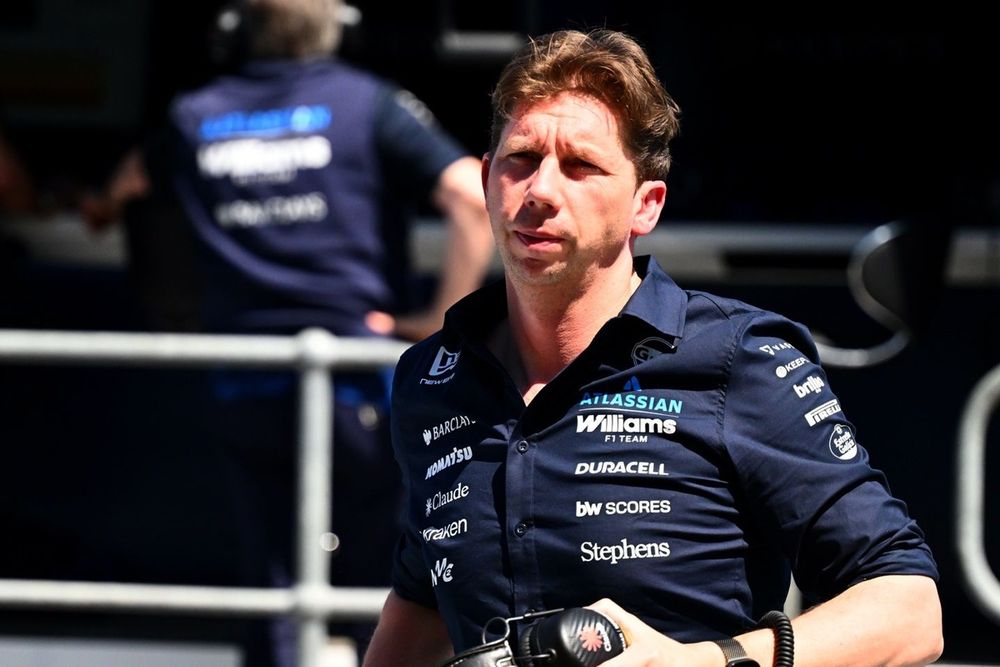
The Weight of Ambition: Inside Williams' Psychological Crucible
The story of the 2026 Formula 1 season is not being written at the front, where a metronomic champion ticks off laps in a sterile vacuum of excellence. It is being written at the back, in the cramped, data-filled garage of Williams Racing. Here, amidst the hollow echo of unmet expectations, we find the raw, human drama this sport was built upon. James Vowles sold a dream of sacrifice for future glory, but the 2026 FW48 is not a phoenix. It is an anchor, dragging down not just lap times, but the very psyches of its drivers and the collective spirit of a historic team. This isn't merely a technical failure; it is a profound psychological breach between ambition and reality.
The Shattered Narrative and Its Human Cost
James Vowles, a man who cut his teeth in the emotion-suppressing machine of Mercedes, understood the power of a story. He framed 2024 and 2025 as sacrificial years, a necessary purgatory on the path to 2026 redemption. This narrative was the psychological contract he offered his team, his drivers, and the world. The FW48's comprehensive flaws have not just broken that contract; they have shredded it.
"The car is simply not good enough," Vowles admitted, a statement of technical fact that carries the emotional weight of a confession.
The drivers, Alex Albon and Carlos Sainz, are now trapped in a reality distortion field. They were promised a weapon for a new war, but were handed a tool for digging a deeper grave. Albon's sarcastic lament that he has complained about handling "for three races in a row" is a flare shot into the sky, a signal of a pilot losing faith in his cockpit instruments. His suggestion that the team blames his driving style is the first crack in the united front, the seed of a corrosive "us versus them" dynamic that can fester in a struggling outfit.
- The FW48's Flaws Are a Psychological Tormentor:
- 20kg Overweight: This isn't just a number on a spreadsheet. For a driver, it's a palpable lethargy in every direction change, a constant, grinding reminder of failure every time they push the brake pedal.
- Aerodynamic Weakness: This translates to a lack of trust. The car does not respond as predicted, breeding hesitation. In a sport of milliseconds, hesitation is a death sentence.
- Production Delays: Skipping the Barcelona shakedown wasn't a scheduling error; it was the first public admission of a loss of control, setting a tone of unreadiness that seeps into the subconscious of every team member.
Carlos Sainz, the ferocious competitor who stared down Ferrari politics, now finds his resilience tested in a different way. His solitary point in China, gleaned from 17th in a lottery, is not a triumph. It is a testament to grinding survival, the kind that Niki Lauda would recognize, but without the tangible hope of a competitive machine. This is the grind that breaks spirits, not forges legends.
The Pressure Cooker of Leadership and the Ghost of Progress
Vowles now sits in the hottest seat in the paddock. His project, his "sternest test," is under a microscope that compares every misstep not to Haas or Alpine, but to the ghost of Williams' own 2025 fifth-place finish. That memory of progress is now a taunt, a benchmark that makes the current plight feel like a betrayal. The pressure is not merely technical; it is existential. Can a leader maintain unity when the core premise of his plan has collapsed at the first hurdle?
This is where driver psychology becomes the critical, unmeasured variable. We focus on cornering speeds and drag coefficients, but we ignore the telemetry of the mind. Albon and Sainz are elite athletes wired for competition. To ask them to be test drivers, to spend seasons "developing" with no hope of glory, is to ask a thoroughbred to pull a cart. Lewis Hamilton mastered the art of channeling frustration into a calculated public narrative, using his past struggles as a shield and a sword. Vowles must now manage two drivers who have not signed up for a perpetual narrative of struggle. Their patience, like that of the stakeholders, is a finite resource, and the meter is running.
The comparison to McLaren's turnaround is inevitable, but it's a dangerous parable. McLaren's recovery was a stunning technical feat, but it was also a psychological miracle. It required an unshakeable belief from Lando Norris and Oscar Piastri that the light at the end of the tunnel was not an oncoming train. Does that belief still exist at Grove? Or has the 2026 miscalculation introduced a seed of doubt that no new front wing can wash away?
Conclusion: The Long Road Back Begins in the Mind
The five-week break until Miami is not a holiday. It is an intensive therapy session for the entire Williams organization. The work to shave kilograms and find downforce is monumental, but it is secondary to the work that must happen between the ears.
This saga exposes the brutal truth of modern F1: you cannot "process" your way to the front. You cannot out-narrative a deficit. Vowles, the strategist, must now become Vowles, the psychologist. He must rebuild the shattered trust of his drivers, convincing them that the data they feel in the seat of their pants is a lie, and that a better truth is being forged in the factory. He must do this while the world watches, and while the specter of his own sacrificed years looms large.
The FW48's problems are a crisis of engineering. But Williams' future will be determined by a battle of psychology. Can they, like Lauda, use this public trauma to forge a harder, more resilient identity? Or will the weight of their ambition continue to drag them under, creating a case study in how a story, once broken, can be impossible to tell again? The stopwatch measures speed. But it is the human heart, pounding against the confines of a flawed machine, that will write the next chapter for this fallen giant.