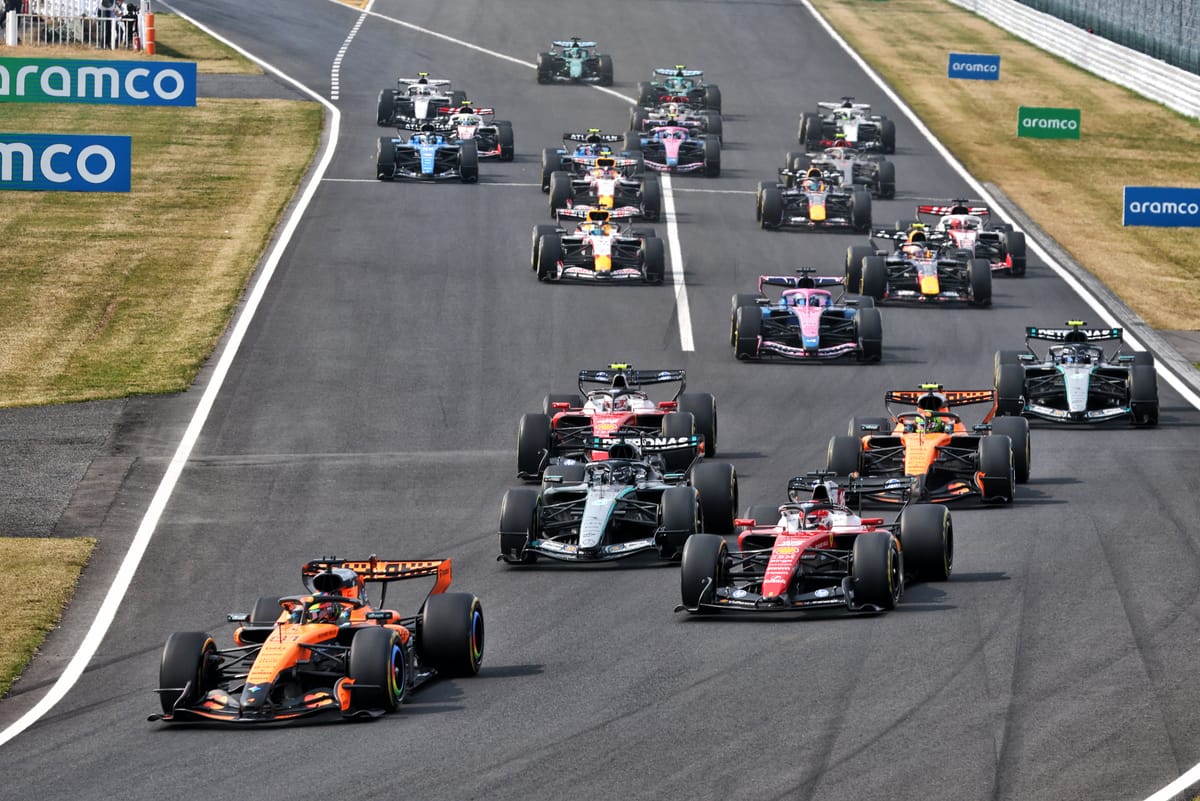
Suzuka's Safety Car: A Legal Loophole Masquerading as Fortune, and the Real Power Shift It Revealed
The official report will call it a racing incident. The highlight reels will focus on Kimi Antonelli’s cool head and Oscar Piastri’s shattered victory. But from where I sit, with whispers of pre-race strategy meetings and post-race tantrums still echoing in my inbox, the 2026 Japanese Grand Prix was not won on the asphalt of Suzuka. It was won in the grey areas of the sporting code, and in the simmering psychological war within Mercedes that has now exploded into the open. Forget the stopwatch; the true timer here is the countdown to George Russell's implosion and the slow, painful unravelling of a certain seven-time champion's Italian dream.
This was a race where a single deployment of the Safety Car didn't just shuffle the order; it acted as a truth serum, revealing the fractures, the desperation, and the cold, hard political calculations that will define this season. The podium was a facade. The real story was in the garage, and in the boardrooms.
The Mercedes Coup: Antonelli's "Fortune" and Russell's Fraying Wire
Let's be brutally clear: Kimi Antonelli did not win this race. The Safety Car, summoned for Ollie Bearman's crash, won it for him. His "composure" was simply the act of not crashing under the pressure of a gift-wrapped lead. But to dismiss this as mere luck is to miss the masterpiece of internal politics at play.
"We got a bit fortunate with the Safety Car," Antonelli said. A bit? That's like calling the '94 Benetton fuel system a "minor calibration advantage." It's the understatement of the era, designed to placate the simmering volcano in the other garage.
The real headline is this: George Russell, the de facto team leader just two races ago, is now a distant second in the championship to a rookie. His weekend was a symphony of errors: a slow start, being mugged by Lewis Hamilton—oh, the delicious, painful irony—on a restart, and a conveniently timed "power deployment issue" that gifted a position to Charles Leclerc. I've seen this movie before. A "technical gremlin" often appears precisely when a driver's morale plummets and the team's focus shifts. It’s not a conspiracy; it’s cause and effect. The machine senses weakness.
Mercedes now has a golden child and a wounded soldier. Toto Wolff will preach unity, but his resources—both technical and psychological—will inevitably flow toward the new points leader. Russell isn't fighting just Antonelli; he's fighting the relentless tide of team politics that always, always backs the coming man. His body language in the cooldown room, watching Antonelli receive the plaudits, told a story of a man realizing the ground has shifted beneath his feet.
The Ghosts of Maranello and the Midfield Revolution
While Mercedes deals with its civil war, let's look at the other "winner": Charles Leclerc. His podium was indeed a psychological boost for Ferrari, but it’s a boost built on a foundation of sand. Why? Because the man they’ve banked their 2027 title hopes on, Lewis Hamilton, was in the other Mercedes, finishing a muted fifth.
Hamilton’s move to Ferrari in 2025 was always a clash of cultures waiting to happen—a flamboyant, activist global icon stepping into the most traditional, conservative, and politically ruthless team in the sport. His performance today, while solid, lacked the killer instinct. He beat Russell in a skirmish, but was nowhere when the real war for the win was happening. I predict the internal strife from that cultural mismatch will consume more energy than their wind tunnel by mid-2027, leaving them vulnerable.
And who capitalizes on that vulnerability? Look lower down. Pierre Gasly in seventh, beating a Red Bull on pure pace, is the canary in the coal mine. My belief that the budget cap will be exploited by the savvy privateers is crystallizing before our eyes. Alpine, unshackled from corporate bloat, is making every euro scream. They are the 2026 version of the 1994 Benetton squad—finding the edges of the regulations while the giants are distracted by their own mythology and internal power struggles. Aston Martin and the Racing Bulls are on the same path. By 2028, the manufacturer teams—Ferrari, Mercedes, the crumbling Red Bull empire—will be playing catch-up to these lean, mean, politically agile operations. Gasly’s P7 was a warning shot.
The Human Cost: Piastri's Lesson in Cold Economics
Now, let us pour one out for Oscar Piastri. His drive was a masterpiece, a genuine defeat of Mercedes on raw pace. And he was robbed. Not by a rival, but by the immutable, unfeeling calculus of the rulebook. The Safety Car is the ultimate political tool—it is democracy in motion, helping the majority (those who haven't pitted) at the brutal expense of the minority (those who have).
His loss is the purest example of my core thesis: team politics and interpersonal dynamics have a greater impact than driver skill. McLaren's strategic call, while logical, was rendered a loser by an external variable. The morale hit in that garage will be immense. Can Zak Brown and Andrea Stella lift them for China? Or does this "missed victory" seed a doubt that will fester, a narrative of "nearly" that becomes a self-fulfilling prophecy? Piastri learned a harsh lesson today: you can be perfect, and still lose. That knowledge changes a driver.
Conclusion: The Championship is a Mood, Not a Metric
So, where does this leave us? Antonelli leads the points, but he sits atop a Mercedes throne that is starting to shake. Russell is a pressure cooker waiting to blow. Hamilton is a king in waiting for a kingdom that may reject his rule. And in the midfield, the true architects of the next era are quietly, efficiently, collecting their points.
Suzuka 2026 proved that the championship is no longer a simple tally of fastest laps and pit stops. It is a mood. It is the morale in Russell's cockpit. It is the confidence flowing through Antonelli’s steering column. It is the simmering frustration in Piastri’s post-race silence. And it is the cold, determined satisfaction in the Alpine garage.
The Safety Car was the catalyst, but the reactions it provoked—the panic, the poise, the political maneuvering—are what truly reshaped the world championship. The cars are closer than ever, which means the decisive weapon is no longer horsepower. It is psychology. And based on today’s evidence, Mercedes’ new golden boy has it, while everyone else is scrambling to find it. The question is, how long can he keep it before the politics of success tear it away?