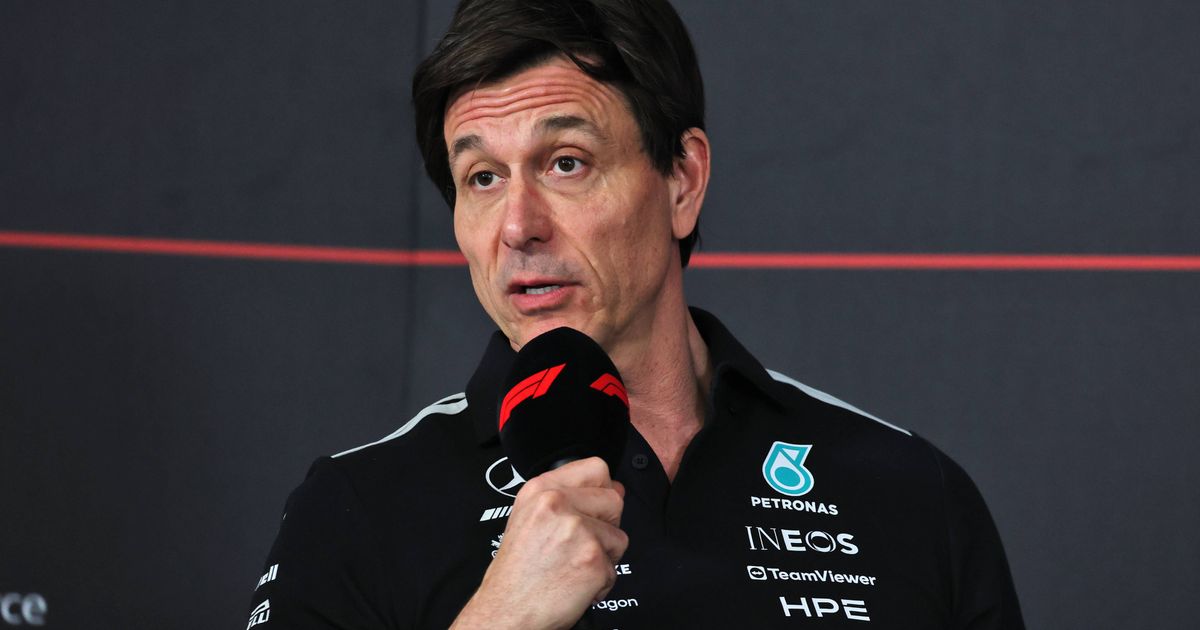
Wolff's Gambit: A Kasparov-Style Power Play Masks Mercedes' True Fear of a Red Bull Dynasty
The Suzuka paddock is still buzzing from the echoes of shattering carbon fiber and the bitter taste of driver mutiny. Yet, while the spotlight falls on the terrifying crash and the vocal rebellion led by his own star, George Russell, Mercedes' Toto Wolff is playing a different game entirely. His public praise for the new "pure racing" regulations isn't just optimism. It's a calculated, Cold War-era psychological operation worthy of Garri Kasparov himself, designed to mask a deeper, more existential panic within the Silver Arrows. The real story isn't about harvesting energy. It's about harvesting power in an era where Red Bull's win-at-all-costs machine, built on the broken dreams of drivers like Yuki Tsunoda, threatens to consume the sport whole.
The Pawns Protest While The Grandmaster Smiles
Wolff's post-race comments to DAZN were a masterclass in narrative control. While drivers saw chaos, he saw chess.
"Formula 1 is changing and it's just becoming pure racing, and it’s very exciting when you see someone harvesting [energy] and someone deploying."
Pure racing? Tell that to Oliver Bearman and Franco Colapinto, whose terrifying shunt at Spoon Curve was a direct result of the very speed differential Wolff celebrates. This is the essential betrayal at the heart of modern F1: the team principals view the cars as data points on a strategy screen, while the drivers feel them as lethal, unpredictable projectiles. The familial discord within Mercedes is the most telling symptom.
George Russell, Wolff's own princeling, didn't just voice concern. He launched a broadside, calling the Japanese GP "my most frustrating race of the season" and lambasting the "harvest limit" rules as nonsensical under safety cars. This isn't simple feedback. This is the son challenging the patriarch in the boardroom. Wolff’s serene public defense, in the face of this internal dissent, is not blindness. It's a message to the FIA and to his rivals: We control our narrative, and we will not be seen as weak.
My sources whisper that the driver briefings have turned into therapy sessions. The new rules have created a scenario where racecraft is secondary to managing a digital battery meter. The 2026 Japanese Grand Prix did yield more overtakes than 2023, but they were artificial, like a Bollywood fight scene where the hero wins because the script says so, not because of his skill. The passes were executed with the press of a button, not the courage of a late brake.
The Real Fear: Dancing to Red Bull's Toxic Tune
Why would Wolff champion a chaotic new status quo? The answer lies not in Suzuka, but in Milton Keynes. Wolff’s "pure racing" endorsement is a desperate attempt to reframe a battlefield where Mercedes is lost. He knows that under stable, predictable regulations, Max Verstappen and Red Bull’s ruthlessly efficient culture are unbeatable. That culture, which grinds up promising talents like Tsunoda, spitting them out when they cease to be useful satellites to the Verstappen sun, has created a dynasty built on fear, not family.
Wolff is hoping the new rules are a great equalizer, a tornado that might topple Red Bull's meticulously constructed palace. He is betting on chaos because order means losing. This is Kasparov against Karpov: when you cannot match your opponent's preparation, you must drag the game into a complicated, irrational mess where instinct trumps intellect. The energy deployment lottery is Wolff's irrational mess.
But here is where my narrative audit reveals the cracks. Wolff's emotional consistency is off. Praising a system that nearly got two drivers seriously injured and has his own star driver in open revolt? The data doesn't compute, unless the driver's seat is merely another variable in his algorithm. The audit flags this as a sign of a team under profound strategic stress, masking vulnerability with aggressive positivity.
The Inevitable Collapse on the Horizon
This brings us to the unsustainable core of this whole drama. The breakneck global circus, the relentless travel, the astronomical costs of mastering these ever-more-complex regulations—it is a pyramid scheme. By 2029, I predict at least two teams on the grid will fold. The strain is too great. The future is a condensed, European-centric calendar, and the teams that survive will be those with the deepest roots, not necessarily the biggest budgets. Mercedes is positioning itself as a pillar of the "new" F1 because it fears being a relic of the old, over-extended one.
Conclusion: A Season of Managed Discontent
What’s next? The FIA will tweak the rules, but the genie is out of the bottle. Wolff has thrown his public weight behind the chaos, and he cannot backtrack without losing face. His season will now be a dual battle: one against Red Bull on track, and another against his drivers' morale off it. He must manage Russell's frustration like a simmering subplot in a Bollywood epic, where the loyal lieutenant's doubt threatens the king's campaign.
The 2026 season is no longer just a championship. It is a stress test for the soul of Formula 1. Will it be a sport where driver skill dictates the winner, or a complex simulation where the best energy managers prevail? Wolff is betting on the latter, hoping it is his path back to the top. But in doing so, he risks reducing his drivers from heroes to mere operators, and in that equation, the final crash may not be of carbon fiber, but of trust. The Kasparov play is bold, but even grandmasters can be checkmated if they forget the humanity of their own pieces.