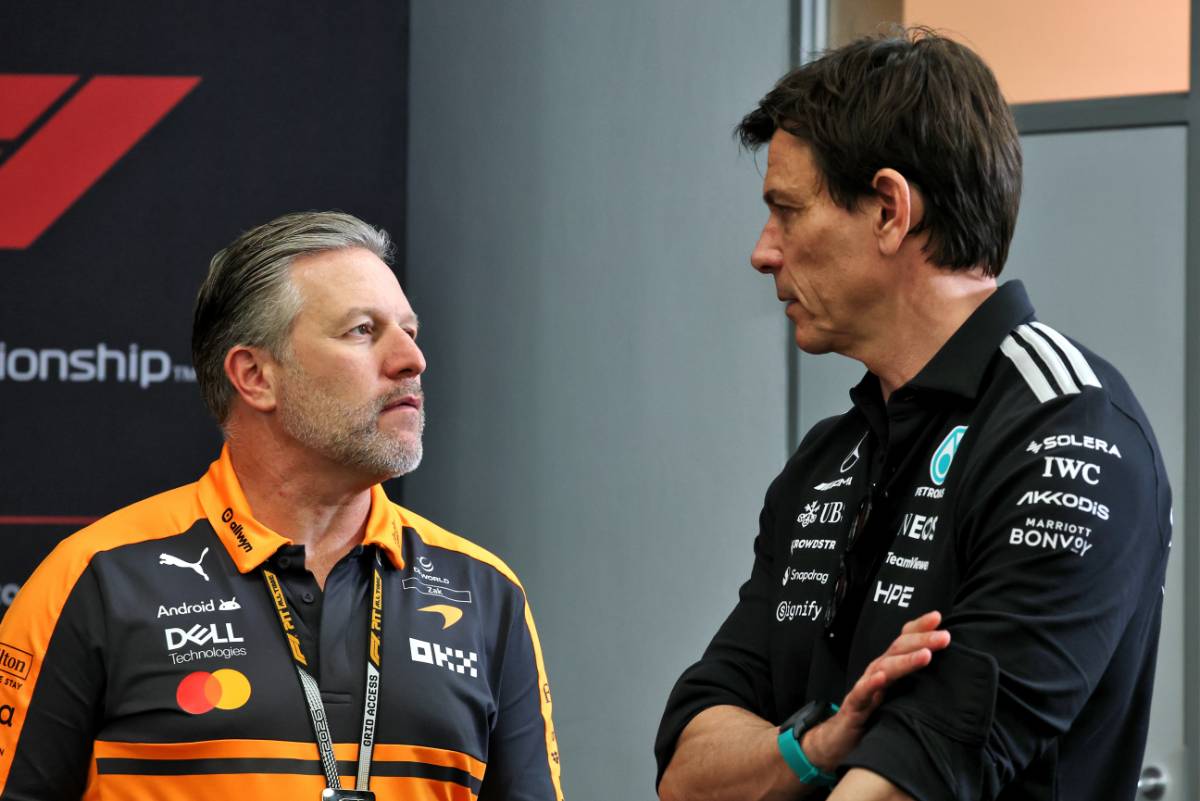
The Ghost in the Machine: Wolff's Denial Exposes F1's New Psychological Frontier
The whispers in the Melbourne paddock weren't about downforce or tire deg. They were about ghosts. A spectral advantage, invisible on the spec sheet, that propelled the Mercedes works cars to a dominant front-row lockout and victory while their customer siblings—armed with identical hardware—floundered in their wake. When Toto Wolff dismisses the notion of a hidden power unit edge, he is technically correct. But in doing so, he inadvertently points to the true battlefield of the 2026 regulations: the space between the driver's ears, and the team's collective psyche. The performance gap isn't forged in the metallurgy of the ICE; it's coded in the software, the strategy, and the symbiotic, almost telepathic relationship a works team cultivates. This isn't a hardware issue. It's a haunting.
The Illusion of Parity and the Weight of Expectation
On paper, the model is pristine. One power unit, four teams: Mercedes, McLaren, Williams, Alpine. A democratic distribution of firepower. Yet the stopwatch in Australia told a different, more brutal story. The disparity was so pronounced it sparked immediate suspicion, a primal reflex in the Piranha Club. Wolff’s rebuttal is a masterclass in logical framing: he cites George Russell’s apt observation that last year, McLaren beat Mercedes with the same engine. The competitive "game," as Russell calls it. But this is not mere setup optimization. The 2026 rules, with electrical energy accounting for roughly half the car’s output, have changed the fundamental sport.
Energy Management as a Mirror of the Mind
The new complex energy management systems are not just engineering puzzles. They are behavioral catalysts. How a driver harvests, deploys, and anticipates energy flow is a continuous, high-stakes decision loop. It requires a cold, predictive rationality that must override instinct. In this realm, the works team holds an insurmountable psychological advantage: total integration. The driver is not a client receiving a tool; he is part of the organism that built it. His biometrics, his cognitive rhythms, his micro-expressions of doubt or aggression in the simulator—they all feed directly back into the software calibration.
"The goal is to 'provide a good service' to all customer teams," Wolff stated. But service is not symbiosis. You cannot outsource a neural link.
Consider the customer drivers. They receive a magnificent, potent engine, but they are forever reacting to its character, negotiating with its quirks. The works driver, particularly one embedded in a culture like Mercedes, becomes the character. This is the unspoken hierarchy. It is the same dynamic that allowed Red Bull to systematically sculpt Max Verstappen’s once-volcanic temperament into a chillingly efficient on-track algorithm. The machinery shapes the mind, which in turn unlocks more from the machinery. The customer teams are fighting a phantom—the ghost of total integration.
The Coming Storm: When Performance Gaps Become Psychological Inquests
Wolff attributes the gap to the "steep learning curve" and "execution." This is the corporate sanitization of a deeply human struggle. Execution under these regulations is a full-system psychological event. What we witnessed in Australia was not a failure of hardware, but a divergence in systemic confidence and cognitive load.
A Prelude to Mandated Disclosure
This incident is a harbinger of my firm belief: within five years, F1 will mandate mental health and cognitive fitness disclosures for drivers after major incidents or sustained performance drops. Imagine if, after Melbourne, we could see the comparative cognitive load metrics of a works Mercedes driver versus a customer driver during a critical qualifying lap. The sheer mental taxation of managing an imperfectly understood energy system, while the works drivers operate on instinct, would be stark. This future transparency will create a new era of accountability, but also a minefield of scandal. Will a driver’s "lack of synergy with PU software integration" become code for a team subtly questioning his mental fortitude? The line between engineering debrief and psychological appraisal is about to vanish.
The focus now, as the article states, shifts to how quickly customer teams can "unlock the potential." This framing is itself a psychological trap. Unlocking implies a secret key, a technical fix. But the key is inside a black box of shared experience and unspoken trust that a customer team can never fully replicate. They are chasing a shadow. As the season develops, the gaps will fluctuate, as Russell noted. These fluctuations will be painted as development curves, but watch closely. They will more accurately mirror the internal stability and psychological coherence of each team. A driver battling his own machine’s unpredictable energy discharge in the rain is not wrestling with physics alone; he is wrestling with anxiety, with a breach of trust in his equipment. That is where races are truly lost.
Conclusion: The Human Element as the Final, Uncopyable Advantage
Wolff’s denial is both true and profoundly misleading. The hardware is equal. The advantage is not. It resides in the imperceptible realm of belief, of seamless communication, of a driver who feels the power unit as an extension of his own will rather than a leased asset. This is the human element, distilled to its most potent and proprietary form.
It brings to mind the calculated personas of champions past. Lewis Hamilton’s meticulously managed public narrative, like Niki Lauda’s post-crash resilience, were psychological fortresses built to protect and project their talent. Today, that fortress is digital, built from code and data streams, but its purpose is identical: to create an environment where the driver’s mind is freed to perform, not to negotiate. The customer teams have the engine map. But they do not have the mind map. And in the cerebral arena of 2026, that is the only map that matters. The ghost in the machine is, and always has been, the human spirit. And spirits are not for sale.