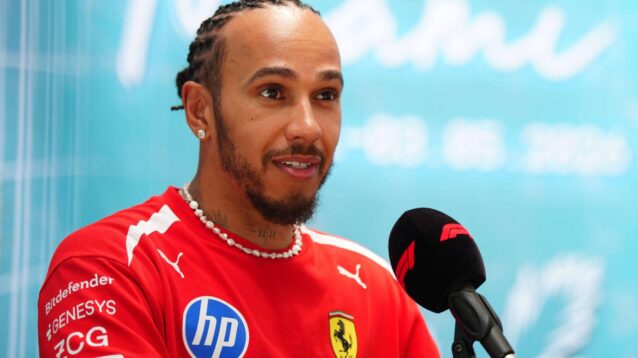
Lewis Hamilton banks on wet-weather testing for Miami GP advantage
Lewis Hamilton hopes his recent intensive wet-weather testing in Ferrari's SF-26 at Fiorano will pay off if rain hits the Miami GP. He claims the car feels good in the rain, a potential advantage as most drivers have limited experience with the new 2026 cars in such conditions. Teammate Charles Leclerc warns of unique challenges, including unexpectedly high straight-line speeds.
Lewis Hamilton believes his extensive recent wet-weather testing in Ferrari's SF-26 could provide a crucial edge if thunderstorms hit the Miami Grand Prix on Sunday. The seven-time champion highlighted his two days of rain running at Fiorano during the April break, suggesting the car feels competitive in those conditions. With the new 2026 cars still largely an unknown in the wet for most drivers, this specific experience may prove to be a significant differentiator.
Why it matters:
In a season where marginal gains define success, any driver with more seat time in specific conditions holds a potential advantage. For Hamilton, adapting to a new team and a radically new car, extra mileage—especially in challenging wet conditions—is invaluable for building confidence and understanding the car's limits. A rain-affected race could shuffle the competitive order, making this preparatory work even more critical.
The details:
- Hamilton completed a Pirelli wet tyre test at Ferrari's Fiorano track over the break, calling it the most wet-weather testing he's done in his career.
- He also experienced wet conditions during the pre-season shakedown in Barcelona, giving him a broader base of data on the SF-26's behavior.
- Teammate Charles Leclerc provided insight into the unique challenges of the 2026 cars in the rain, noting they can feel "quite nice" in corners due to their light weight.
- Leclerc highlighted a counter-intuitive quirk: cars may reach higher speeds at the end of straights in the wet because there is less need for energy harvesting, leading to reduced engine power cuts.
- This creates a dangerous scenario with high closing speeds and poor visibility, making drivers "passengers" who must assume others are traveling at similar speeds.
- Despite the filming day at Monza, where Ferrari was spotted testing its rotating rear wing, Hamilton stated he "didn't learn anything" from that session, emphasizing the value of the dedicated wet-weather test instead.
What's next:
All eyes will be on the Miami skies this weekend. If the forecasted storms arrive, Hamilton's focused preparation could translate into a tangible performance benefit, potentially allowing him to navigate the tricky conditions with more assurance than rivals. However, as Leclerc pointed out, the unpredictable nature of the new cars in the wet, particularly regarding closing speeds, means any wet race will be a high-stakes test of skill, strategy, and luck for the entire grid.
Don't miss the next lap
Get the deep dives and technical analysis from the world of F1 delivered to your inbox twice a week.
Zero spam. Only high-octane analysis. Unsubscribe anytime.
Join the inner circle
Get the deep dives and technical analysis from the world of F1 delivered to your inbox twice a week.
Zero spam. Only high-octane analysis. Unsubscribe anytime.
Continue Reading
View More News