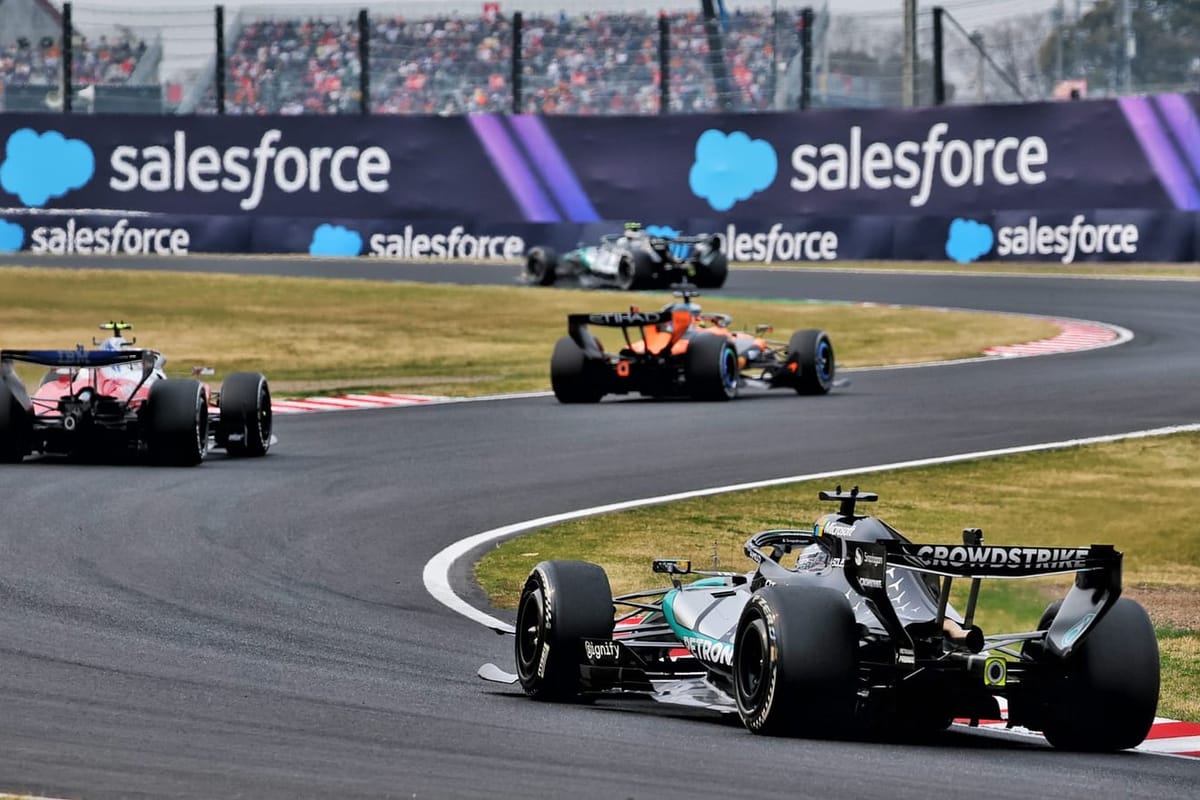
Mercedes' Early-Season Start Woes Analyzed
Despite having one of the fastest cars, Mercedes has failed to lead into Turn 1 all season, with poor race starts and safety car restarts forcing its drivers into recoveries. The team believes the issues are operational and track-specific, not fundamental, and has made technical progress to match rivals off the line.
Mercedes has locked out the front row at every race this season but has yet to lead into the first corner, a curious weakness that has forced its drivers into dramatic fightbacks. While the team jokes this makes races more exciting, internal analysis reveals the issues are more operational than fundamental, with recent progress masked by track-specific quirks and isolated mistakes.
Why it matters:
For a team with a car considered among the fastest on the grid, consistently losing positions at the start is a critical strategic handicap. It forces drivers to use more tire and battery life to recover lost ground, compromising optimal race strategy and handing early initiative to rivals like Ferrari and McLaren.
The details:
- Japan's Specific Challenges: The poor getaways in Suzuka were not a repeat of earlier technical problems. For polesitter Kimi Antonelli, it was an overly aggressive clutch drop on a track where rear tires were not at ideal temperature. For George Russell, the downhill slope of the grid required trail braking, and a slow release of that brake pressure hampered his second-phase acceleration.
- Safety Car Restart Troubles: Mercedes has also struggled on restarts. In Japan, Russell was overtaken twice after the safety car period due to energy management issues.
- First, he hit the 2026-mandated single-lap recharge limit while forming up, leaving his battery empty and allowing Lewis Hamilton to pass.
- Later, a "software glitch" triggered a 'super clip'—an unintended power surge—while the team was experimenting with harvest settings, which compromised his exit and let Charles Leclerc through.
- Underlying Progress: Despite the results, Mercedes' GPS data from practice starts indicates their procedures and power unit settings are now competitive with Ferrari and McLaren off the line. The core issues in Australia (formation lap recharge limits causing cold tires) have been addressed.
What's next:
The focus shifts to Miami, where Mercedes will aim to convert its qualifying pace into a clean first-lap lead. Antonelli has identified clutch feel as a personal area for improvement, while the team will refine its restart energy management protocols to avoid the operational errors that cost Russell in Japan. If these execution elements are perfected, Mercedes' inherent car speed could finally be unleashed from the very beginning of the race.
Don't miss the next lap
Get the deep dives and technical analysis from the world of F1 delivered to your inbox twice a week.
Zero spam. Only high-octane analysis. Unsubscribe anytime.
Join the inner circle
Get the deep dives and technical analysis from the world of F1 delivered to your inbox twice a week.
Zero spam. Only high-octane analysis. Unsubscribe anytime.
Continue Reading
View More News