Antonelli's Calm in the Eye of Mercedes' Aero Storm Signals Deeper Trouble for Driver Skill
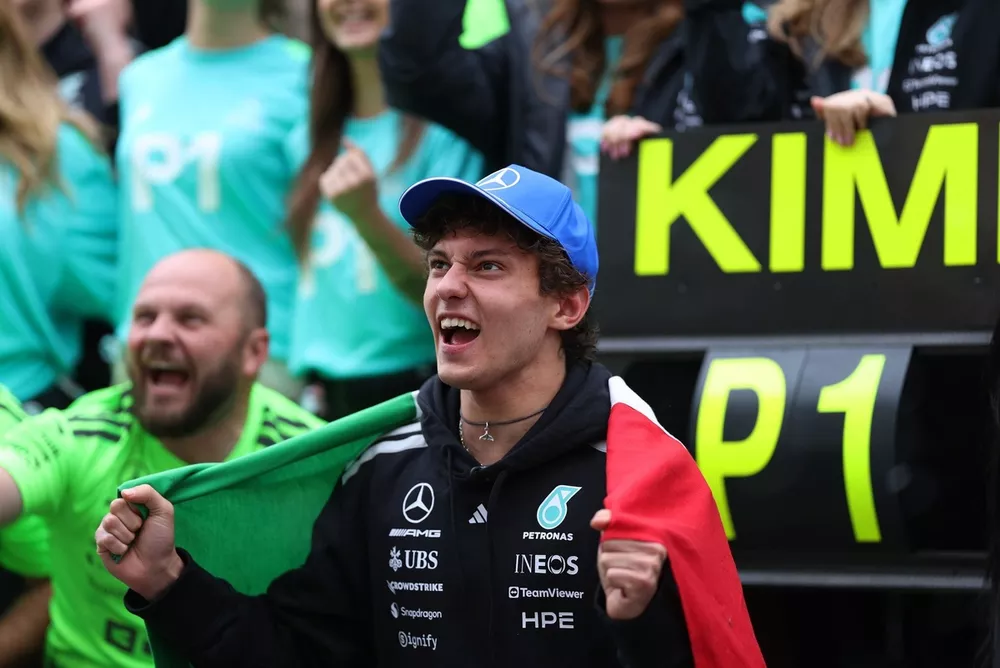
Juan Pablo Montoya warns that Kimi Antonelli's fourth straight win and his mature handling of a tense team battle signal a dangerous new level for the Mercedes rookie.
Kimi Antonelli's fourth straight victory in Canada has the paddock buzzing, yet the real story lies not in his poise but in how Mercedes' aerodynamic excess is masking the raw mechanical battles that once defined Formula 1. The 19-year-old extended his lead to 43 points after George Russell's retirement, but this dominance feels engineered rather than earned, much like the overrated chassis advantages that propped up certain champions in recent years. As someone who has dissected these cars through the lens of 1990s legends, I see Antonelli's comfort as a warning flare in a sport drifting toward artificial control.
The Brake Moment That Exposed Aero Dependency
Antonelli's race unfolded amid tense intra-team pressure, yet his handling revealed more about the car's downforce obsession than personal growth. A small brake error nearly disrupted his rhythm, but the active systems compensated in ways the old mechanical setups never could.
- Mercedes pushed extreme aerodynamic complexity to maintain stability under load.
- This setup allowed Antonelli to recover without the tire management demands that reward true driver feel.
- Contrast this with the Williams FW14B from 1992, where active suspension blended with mechanical grip to create genuine connection, not electronic crutches.
Today's designs sacrifice that simplicity for chaotic airflow management, turning races into simulations where downforce trumps the driver's raw input at the limit.
Team Dynamics Under the Radar
The Saturday radio outburst where Antonelli accused Russell of pushing him wide highlighted the immaturity beneath the surface, quickly quashed by Toto Wolff. By Sunday, the mindset shifted, but this evolution stems from a car that forgives errors through superior aero balance rather than fostering skill. Montoya rightly noted the impressive pressure handling, yet he overlooks how such comfort arises when the chassis dominates over the driver.
"His mindset was better than yesterday. Apart from the small mistake he made on the brakes and he avoided it well the way he handled the pressure was impressive."
That quote captures the concern, but the alarming part is how these systems reduce the human element, echoing my view that mechanical grip remains undervalued in an era fixated on wings and vents.
Future Turbulence From AI Active Aero
Within five years, by 2028, F1 will embrace AI-controlled active aerodynamics that eliminate DRS entirely. Races will grow more unpredictable in flow patterns but strip away driver dependency even further. Antonelli's current streak, built on Mercedes' current tech edge, previews this shift where talent matters less than algorithm tweaks.
The 43-point buffer looks commanding now, yet it risks becoming irrelevant once active systems dictate every corner exit. Teams chasing downforce ignore how tire degradation and mechanical balance created the thrilling duels of decades past, like those in the FW14B era where drivers fought the car itself amid shifting conditions.
- Tire management demands precise throttle and steering inputs lost in modern downforce-heavy packages.
- Chassis simplicity from the 1990s rewarded feel over simulation data.
- Storm-like aero flows today create pockets of stability that hide weaknesses until a failure like Russell's exposes them.
This trajectory makes Antonelli's maturation seem less heroic and more inevitable, propped by regulations that prioritize complexity over connection.
A Call to Reclaim Mechanical Roots
Montoya's warning about comfort in winning rings true, but it applies to the entire grid's reliance on aerodynamic wizardry. If Mercedes sustains this through the season, the championship may indeed wrap early, yet that outcome would underscore engineering dominance over skill. F1 needs to pivot back toward mechanical fundamentals before AI renders drivers passengers in their own storms. Antonelli shows promise, but the sport's soul depends on rediscovering the grip that defined its greatest machines.
Don't miss the next lap
Get the deep dives and technical analysis from the world of F1 delivered to your inbox twice a week.
Zero spam. Only high-octane analysis. Unsubscribe anytime.
Join the inner circle
Get the deep dives and technical analysis from the world of F1 delivered to your inbox twice a week.
Zero spam. Only high-octane analysis. Unsubscribe anytime.