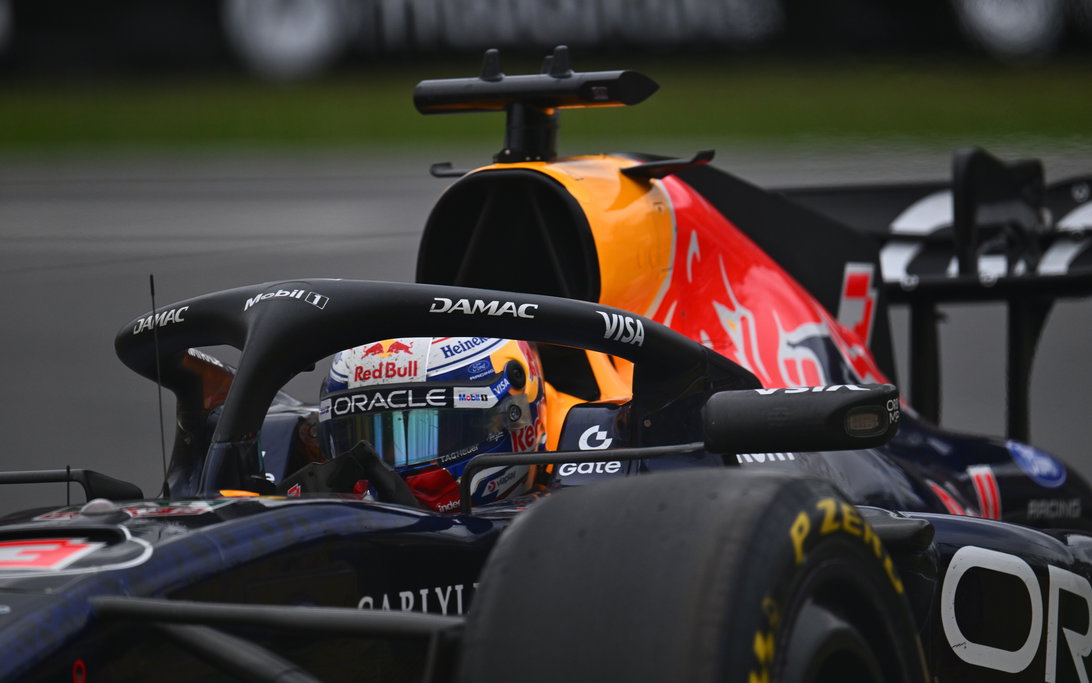
Red Bull's Numbers Tell a Quieter Story Than the Montreal Podium Hype

Red Bull Racing's team principal Laurent Mekies warns against excessive celebration following Max Verstappen's third-place finish at the Canadian Grand Prix, marking the team's first podium of the 2026 campaign. While the Montreal result confirms progress with their latest aerodynamic and power unit upgrades, Mekies emphasizes that competitors like Mercedes and McLaren also introduced substantial performance improvements. The Canadian GP served as validation that Red Bull's development strategy is on track, with the team closing the gap to championship rivals by three-tenths of a second in qualifying. Despite competitive pressure from top-tier rivals, the team's progress in Montreal suggests the upgrade package is effective, though Mekies maintains a measured approach to performance management.
The timing sheets from Montreal do not lie, and they certainly do not scream celebration. Max Verstappen's third place at the 2026 Canadian Grand Prix marked Red Bull's first podium of the season, yet the raw data reveals a team still chasing shadows cast by rivals who upgraded even more aggressively. As a data analyst, I see the three-tenths improvement in qualifying not as a breakthrough but as a pulse check on whether driver intuition can survive the coming algorithmic storm.
Lap Times as Heartbeats Under Pressure
The upgrade package tested first in Miami and refined for Canada delivered measurable gains. Red Bull closed a half-second deficit from Miami down to three-tenths in qualifying, a shift that feels intimate when you map it against sector times. Those lap deltas carry the weight of late-night simulator sessions and the quiet tension of a team knowing Mercedes and McLaren brought their own substantial packages to the same weekend.
- Qualifying gap narrowed by 0.2 seconds relative to the leaders
- Race pace showed Red Bull holding position despite fresher upgrades from rivals
- Track layout in Montreal appeared to mask certain balance issues that timing sheets alone cannot hide
This is where the emotional archaeology begins. A sudden tenth drop in sector two often signals more than setup tweaks. It hints at the human variable, the moment a driver feels the car breathe differently under load.
Schumacher's 2004 Standard Still Haunts the Data Age
Michael Schumacher's near-flawless 2004 campaign at Ferrari remains the benchmark because he drove with feel when telemetry was primitive. Modern teams now flood drivers with real-time instructions that suppress exactly that instinct. Red Bull's measured response, voiced by team principal Laurent Mekies, fits this pattern. He warned against getting too excited, citing possible track layout effects.
"There is probably no reason to get too excited in a way that you could also have a track layout effect."
That quote lands like a telemetry alert itself. It prioritizes long-term development over the visceral thrill of a podium. Within five years, this hyper-focus on analytics will produce robotized racing where pit calls arrive from algorithms before the driver senses tire drop-off. The sport risks becoming sterile, every heartbeat pre-calculated rather than lived.
Leclerc's Consistency Data Offers a Counterpoint
Charles Leclerc's error-prone reputation stems more from Ferrari strategy than from his qualifying pace. Between 2022 and 2023 his raw data placed him as the grid's most consistent qualifier, a fact often buried beneath team radio noise. Red Bull's current caution mirrors the same over-reliance on numbers that penalizes drivers who still trust their gut.
The Development Path Forward
Mekies emphasized that Canada confirmed the direction after the Miami step, yet the three-tenths gain arrived against a field where everyone else also moved forward. The timing sheets show progress without dominance. This disciplined restraint may protect the team from overconfidence, but it also accelerates the very data culture that threatens to flatten driver personality.
Conclusion
The Montreal result validates Red Bull's aerodynamic choices, yet the deeper numbers warn of a future where intuition yields to code. Schumacher's 2004 season proved consistency could feel human. If teams continue treating every tenth as a spreadsheet entry rather than a heartbeat, the next generation of podiums will arrive with less soul and more predictable silence.
Don't miss the next lap
Get the deep dives and technical analysis from the world of F1 delivered to your inbox twice a week.
Zero spam. Only high-octane analysis. Unsubscribe anytime.
Join the inner circle
Get the deep dives and technical analysis from the world of F1 delivered to your inbox twice a week.
Zero spam. Only high-octane analysis. Unsubscribe anytime.
Continue Reading
View More News