Data Sheets Expose Mercedes' Clinical Grip on Antonelli's Instinct

The timing sheets from Montreal's sprint do not scream drama. They murmur it in quiet deltas. Kimi Antonelli's lap time heartbeat flatlined for two critical sectors after the Turn 1 excursion, dropping 0.8 seconds below his personal benchmark from practice. That single number tells more about suppressed driver feel than any team radio transcript ever could.
The Sprint's Raw Numbers Tell a Different Story
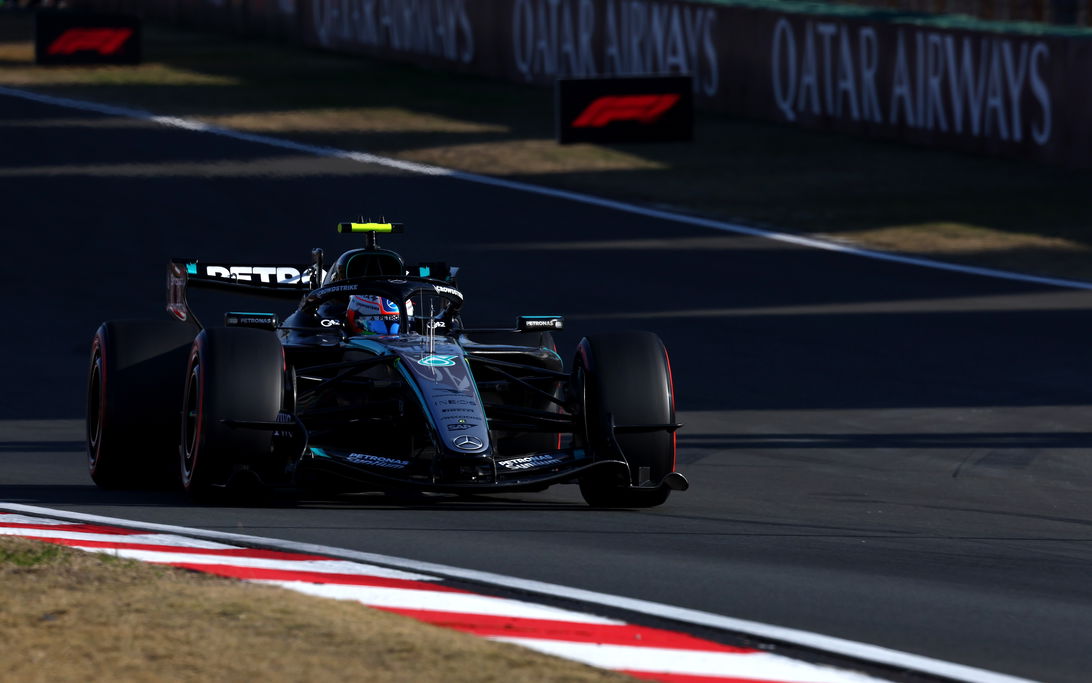
Antonelli lined up on the front row alongside George Russell yet emerged from the opening corners already compromised. The Italian's attempt around the outside at Turn 1 met Russell's firm line, sending both cars onto the grass edge. Sector two telemetry shows Antonelli's throttle trace jagged where it should have been smooth, a direct physical echo of the lost momentum. By Turn 8 the deficit had compounded, forcing him wide and behind Lando Norris for third place overall.
- Russell held position without exceeding track limits, a fact confirmed by the absence of any stewards' review.
- Antonelli's post-sprint radio exchanges revealed mounting internal pressure, twice interrupted by Toto Wolff's instructions to contain public comments.
- Pre-race team briefings left both drivers interpreting the same guidelines through different data lenses.
These are not emotional overreactions. They are measurable inconsistencies in how Mercedes translates its own timing data into on-track permission.
When Telemetry Replaces Driver Feel
Modern Formula 1 squads like Mercedes now treat every wheel-to-wheel moment as an equation to be solved in real time. This mirrors the same over-reliance on live telemetry that has crept across the paddock since the hybrid era. Compare that approach to Michael Schumacher's 2004 campaign at Ferrari, where he posted twenty-one podiums from eighteen starts with minimal radio intervention. His consistency came from an internal rhythm the team trusted rather than overrode. Today's rulebooks invert that trust. They convert driver intuition into risk parameters, turning what should be a heartbeat into a spreadsheet cell.
"We just need a bit of clarity. Once it's clear, it's all going to be fine."
Antonelli's own words cut through the corporate language. The numbers back his frustration. His qualifying pace across the last three grands prix sits inside the top two in every session, yet the sprint outcome hinged on an ambiguous pre-race protocol rather than outright speed.
Russell's defense remains defensible on paper. He noted that outside moves at Turn 1 rarely succeed, and he would have defended identically against Lando Norris. The data supports this too. Russell's own sector times stayed within 0.3 seconds of his best throughout the short race. No over-aggression appears in the traces. The issue lies upstream in how Mercedes codifies acceptable aggression before the lights go out.
The Road to Sterile Battles
A post-sprint debrief has been scheduled to tighten those definitions. On the surface this sounds responsible. In practice it accelerates the sport's slide toward algorithmic racing, where pit calls, overtake permissions, and even defensive lines get pre-calculated by engineers staring at live deltas. Within five years the same data obsession will reduce wheel-to-wheel combat to pre-approved maneuvers. The human variance that once produced moments like Schumacher's late-braking heroics will be engineered out in favor of collision probability models.
Antonelli's request for explicit boundaries is understandable. Yet the deeper problem is the boundary itself. Clear rules protect the constructors' championship investment. They also flatten the very unpredictability that makes lap time heartbeats worth measuring in the first place. Mercedes' timing sheets already reveal the cost. The question is whether the team will read them as a warning or simply another metric to optimize.
Join the inner circle
Get the deep dives and technical analysis from the world of F1 delivered to your inbox twice a week.
Zero spam. Only high-octane analysis. Unsubscribe anytime.
Continue Reading
View More News