The Unseen Fracture in the Cockpit: How Reliability Demons Are Cracking Lance Stroll's Mental Armor Before 2026 Even Begins
In the sterile silence of the Bahrain garage, Lance Stroll sits strapped into the AMR26, his heart rate spiking on unseen biometric feeds while engineers scramble over a Honda power unit that has already betrayed him once today. The numbers tell only half the story: just 36 laps completed on that opening test day, a full power unit swap forced by anomalies in the data, and an engine deliberately capped below 11,000 RPM. What the telemetry cannot capture is the quiet erosion inside the driver's mind, the same corrosive doubt that has haunted ambitious teams when early gremlins turn pre-season into a psychological endurance race rather than a performance hunt.
The Limited Program as Mental Sabotage
Aston Martin's deliberate restraint in those early Bahrain runs was meant to protect the hardware, yet it exposed something far more fragile. Stroll never pushed beyond 300 km/h on the main straight. Every lap became an exercise in restraint rather than release.
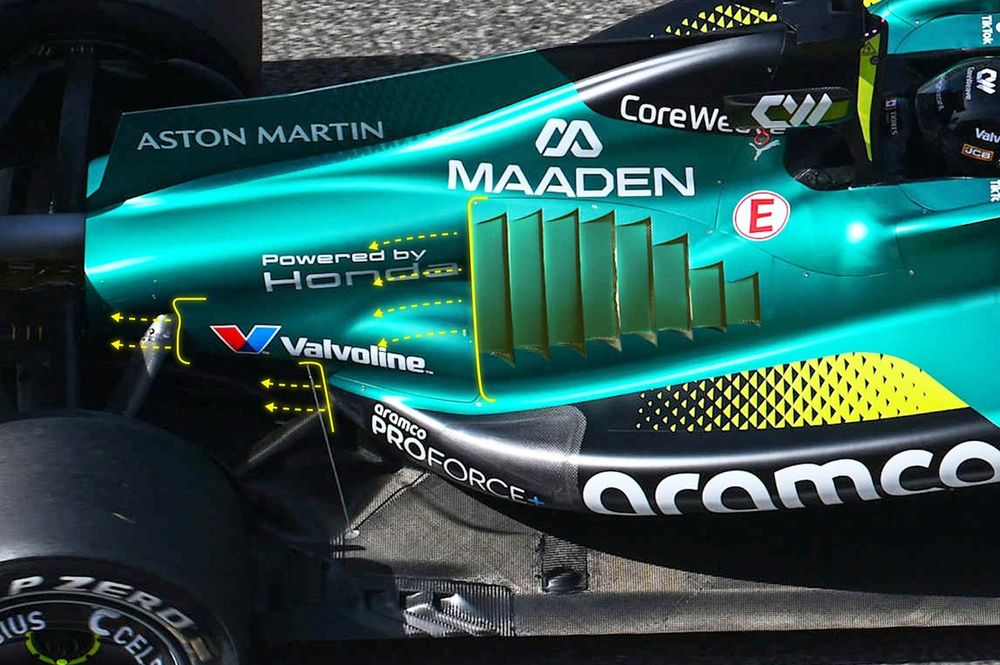
- Engineers monitored cooling "gills" hastily cut into the engine cover after aggressive sidepod packaging created overheating.
- The tapered rear bodywork, echoing Red Bull's RB20 concepts, traded aerodynamic purity for survival.
- Each vented compromise whispered to the driver that the car was not yet whole.
This is where driver psychology begins to outweigh chassis design. In conditions of engineered uncertainty, the mind fills the gaps with worst-case scenarios. Stroll's limited mileage did not merely starve the team of correlation data; it starved him of the visceral feedback needed to trust the machine.
Cooling Vents and the Lauda Shadow
Fernando Alonso took over on day two and managed 55 laps, a modest improvement that still prioritized system checks over outright pace. The contrast between the two drivers reveals the human variable no wind-tunnel can measure. Alonso has long mastered the art of compartmentalizing mechanical doubt, a trait forged in fires that echo Niki Lauda's post-crash resilience. Lewis Hamilton, too, has turned calculated public restraint into armor, transforming personal trauma into narrative control that often overshadows raw speed.
Stroll lacks that same practiced detachment. When the Honda unit faltered after the Barcelona shakedown, the interruption was not merely logistical. It was an intimate violation of the driver's expected rhythm. Speculative inner monologues likely played on loop in the cockpit: Will the next lap expose another anomaly? Can I commit to the apex if the power delivery feels fragile? These questions surface most clearly under uncertainty, exactly where personality traits engineers cannot design around become decisive.
"The car feels different when you know it might betray you mid-corner," one team insider admitted off-record, capturing the quiet terror reliability issues inject into even the most seasoned minds.
The Road to Mandated Transparency
These early Bahrain struggles force Aston Martin into reactive mode, chasing durability before the season opener rather than chasing rivals. Yet the deeper consequence lies ahead. Within five years, Formula 1 will almost certainly mandate mental health disclosures after major incidents, ushering in an era where biometric spikes like Stroll's elevated heart rate become public record. The scrutiny will intensify, scandals will follow, and teams will face pressure to treat driver psychology with the same rigor once reserved for power unit mapping.
For now, the AMR26 remains an aerodynamically extreme statement hampered by heat and doubt. The true test is not whether Aston Martin can add more gills or refine the packaging. It is whether Lance Stroll can rebuild the inner certainty that every champion, manufactured or otherwise, ultimately requires when the machine itself feels unreliable.
Join the inner circle
Get the deep dives and technical analysis from the world of F1 delivered to your inbox twice a week.
Zero spam. Only high-octane analysis. Unsubscribe anytime.
Continue Reading
View More News