The Manufactured Champion's Mask Slips: Verstappen's Ejection Reveals Red Bull's Hidden Grip on His Psyche
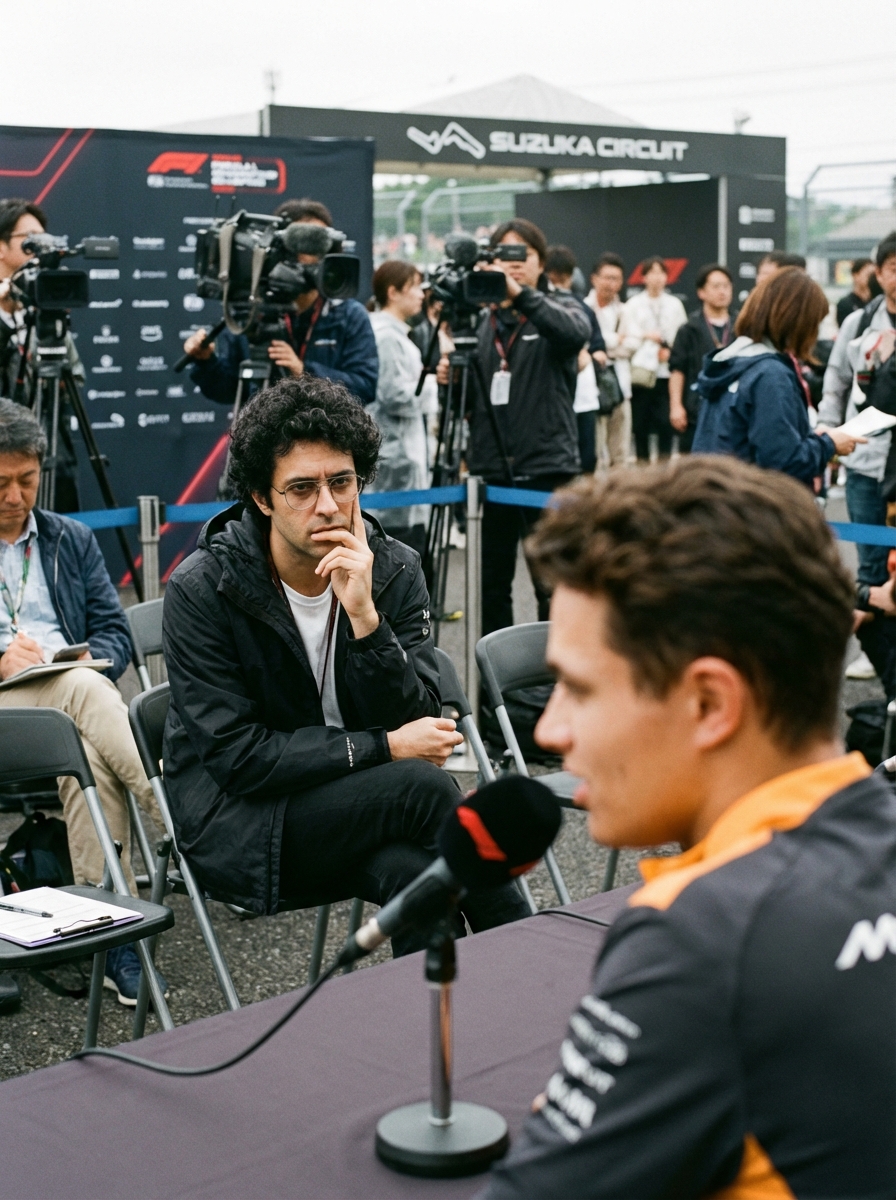
In the humid press room at Suzuka, Max Verstappen did not merely refuse a question. He orchestrated an expulsion that laid bare the fragile architecture of a champion engineered for control. The air thickened with unspoken telemetry, heart rates spiking on unseen monitors as the reigning title holder demanded Giles Richards depart before any words could flow. This was no simple media standoff. It was the quiet rupture of years spent under Red Bull's systematic emotional containment.
The Echo from Abu Dhabi That Refused to Fade
Verstappen's decision carried the weight of a prior wound, one inflicted during the 2025 season's closing chapters. Richards had probed the mid-season collision with George Russell, a moment that shaved vital points from Verstappen's tally in his eventual narrow loss to Lando Norris. That exchange lingered like residual downforce imbalance, impossible to trim away.
- The journalist's role demanded repetition of uncomfortable truths.
- Verstappen's response bypassed protocol entirely, halting the session until Richards exited.
- No FIA intervention followed, despite the public nature of the removal.
Coulthard captured the oddity precisely on the Up To Speed podcast, noting Verstappen's right to decline answers yet labeling the ejection itself unusual. He contrasted it with the governing body's swift penalties for profanity, underscoring an inconsistent enforcement that leaves drivers navigating their own psychological boundaries.
Inner Monologues Under Surveillance
Picture the biometric feed during that Suzuka standoff. Verstappen's pulse likely climbed past 140 beats per minute, not from physical exertion but from the collision of suppressed memory and present scrutiny. Red Bull's covert psychological coaching has long functioned as an invisible damper, muting outbursts that once defined his raw talent. The result is a manufactured champion whose dominance stems less from pure instinct and more from engineered restraint.
This approach treats emotional spikes as variables to be calibrated, much like tire degradation curves. Yet in moments like these, the system reveals its seams. Drivers under such regimes often carry internal dialogues that blend defiance with dread, replaying past collisions while calculating media fallout in real time. The ejection served as a rare public leak from that pressurized cockpit.
Psychology Over Protocol in the Press Room
Coulthard drew from his own history with relentless questioning, acknowledging how such exchanges burrow beneath the skin. He framed it as an inevitable friction, one journalists must pursue even when it wounds. Verstappen's action, however, bypassed that dance entirely.
"It is unusual that the FIA did not step in," Coulthard observed, highlighting the contrast with routine fines for verbal slips.
This silence sets a precedent where personal grievance can override structured access. It also foreshadows the coming mandate for mental health disclosures, expected within five years after major incidents. Transparency will arrive, yet it will amplify scrutiny, turning every telemetry spike into headline fodder and every suppressed outburst into potential scandal.
Hamilton's Calculated Armor and the Lauda Parallel
Verstappen's episode invites comparison to Lewis Hamilton's carefully constructed public face, one forged in the aftermath of personal and professional trials. Like Niki Lauda, who rebuilt narrative from the ashes of Nürburgring trauma, Hamilton weaponized resilience to eclipse raw speed with story. Verstappen, by contrast, operates under a different regime, one that buries rather than reframes the fracture points.
The Road to Mandated Transparency
The FIA's inaction today plants seeds for tomorrow's reckonings. Drivers may test stricter boundaries in media settings, while journalists adjust their angles to probe deeper. Yet the deeper shift lies in the cockpit, where decision-making under pressure already reveals traits no aerodynamic package can mask. Within five years, required disclosures will force these inner landscapes into daylight, transforming therapy sessions into public data points and lap times into psychological records.
The sport will gain clarity. It may also lose the last illusions of untouchable composure.
Join the inner circle
Get the deep dives and technical analysis from the world of F1 delivered to your inbox twice a week.
Zero spam. Only high-octane analysis. Unsubscribe anytime.