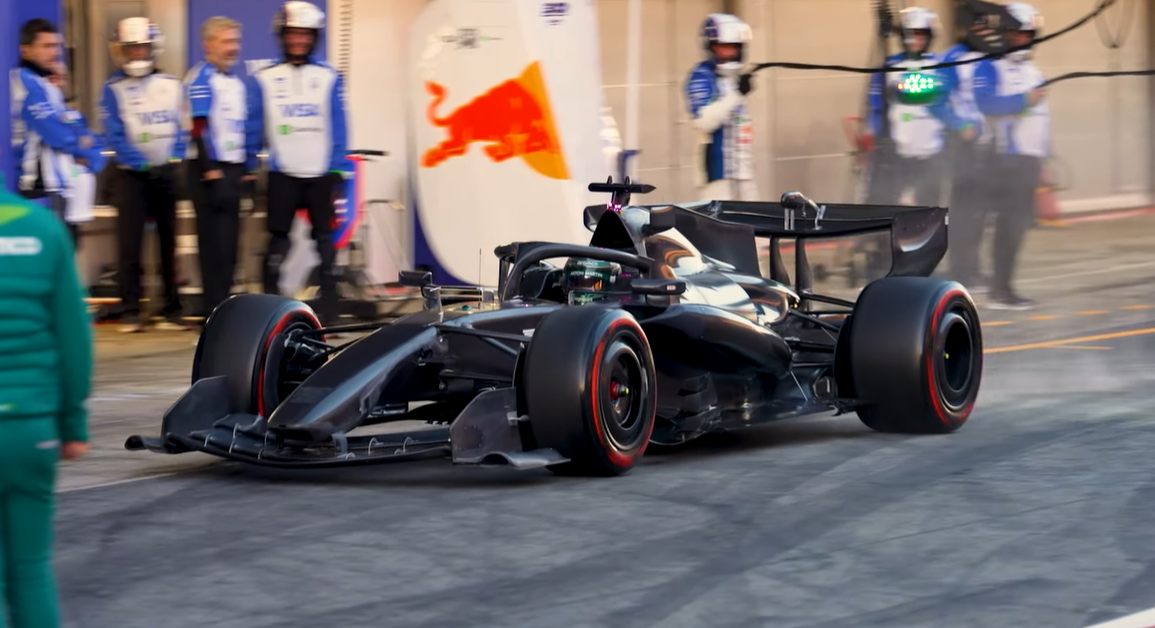
Deep look into the insides of AMR26's arodynamic

Modern Formula 1 aerodynamics are not based solely on generating maximum downforce, but on optimizing flow efficiency across the entire car. Under air conditions of 10 °C and 1 atmosphere, where air density is slightly higher than standard, aerodynamic effects are amplified, both in downforce and drag. In this context, we analyze how a modern single-seater manages airflow from the cockpit to the rear, with special focus on the suspension, rear wing, and —creative— regulatory compliance.

Air conditions and aerodynamic context
At 10 °C and standard atmospheric pressure, air density is approximately 1.247 kg/m³, which implies:
- Higher potential for downforce generation.
- A parallel increase in drag if the flow is not properly controlled.
- Greater ease in keeping the flow attached to surfaces.
This makes aerodynamic efficiency —the lift-to-drag ratio— the true design objective.
The area behind the cockpit: the flow tipping point
The region immediately behind the cockpit is one of the most critical areas of the car. The air reaching this zone has already been accelerated and conditioned by:
- The nose.
- The front suspension.
- The sidepods.
However, it also arrives partially contaminated by turbulence generated by the front wheels. The goal of this section is to reorder and re-energize the flow before it feeds the floor, diffuser, and rear assembly.
Key design features
- Progressive bodywork transitions, avoiding abrupt separations.
- Generation of controlled micro-vortices, instead of large chaotic separations.
- Careful flow management around the airbox to avoid downstream stability penalties.
The result is a stable low-pressure zone that enhances floor extraction and improves diffuser performance, increasing downforce without a significant drag penalty.
Rear suspension: when mechanics become aerodynamics
The positioning of the rear suspension arms, very close to the rear wing’s main plane, follows a purely aerodynamic philosophy.
Aerodynamic benefits
- The arms act as secondary profiles, generating vortices that energize the flow.
- They help delay rear-wing stall, especially in high-downforce configurations.
- They improve interaction between diffuser outflow and the rear wing.
- They reduce the turbulent wake, benefiting overall efficiency and DRS effectiveness.
Technical trade-offs
- Increased sensitivity to yaw angle, especially in slow corners.
- Constraints on mechanical suspension design (anti-squat, toe settings).
- A narrower operating window, highly dependent on ride height.
This is therefore a high-performance but high-complexity solution.
Front suspension: organizing aerodynamic chaos
In modern F1, the front suspension is as much an aerodynamic device as a structural one. Its primary mission is to manage the highly turbulent air generated by the front wheels.
Main functions
- Generate vortices that push dirty air upward and outward.
- Protect the flow directed toward the sidepods.
- Seal the floor edges to prevent pressure losses.
Although regulations enforce an inwash concept, suspension geometry allows inducing flow rotations that, in practice, create a lateral cleaning effect without directly violating the rules.
The role of the sidepod: turning inwash into outwash
One of the most sophisticated aspects of the design lies in using the sidepod as an active aerodynamic tool.
The mechanism
- The flow arrives formally compliant with the regulatory inwash.
- The sidepod geometry —especially its upper edge and lateral drop— accelerates the air.
- The change in plane and acceleration induce an indirect outwash, legal from a regulatory standpoint.
This process generates a long, stable vortex that:
- Expels dirty air from the front wheel.
- Feeds the floor and diffuser with cleaner, more energetic air.
At lower temperatures, such as the analyzed 10 °C, this vortex remains more coherent and loses less energy.
Conclusion: efficiency as a global philosophy
This single-seater does not chase isolated maximum downforce, but an integrated efficiency across the entire package. Each element works in sequence:
- The front suspension organizes the flow.
- The sidepod turns regulatory constraints into an advantage.
- The rear cockpit area re-energizes the air.
- The rear suspension amplifies diffuser and rear-wing performance.
The result is a car with an extremely refined aerodynamic platform, capable of delivering high performance with minimal drag penalty, particularly effective in dense, stable air conditions.
Join the inner circle
Get the deep dives and technical analysis from the world of F1 delivered to your inbox twice a week.
Zero spam. Only high-octane analysis. Unsubscribe anytime.
.png?alt=media&token=c14086ca-5fc6-4d2e-8473-098da2832b60)