Data Doesn't Lie: How Schumacher's 2006 Monaco Timing Sheets Still Pulse With Unanswered Pressure

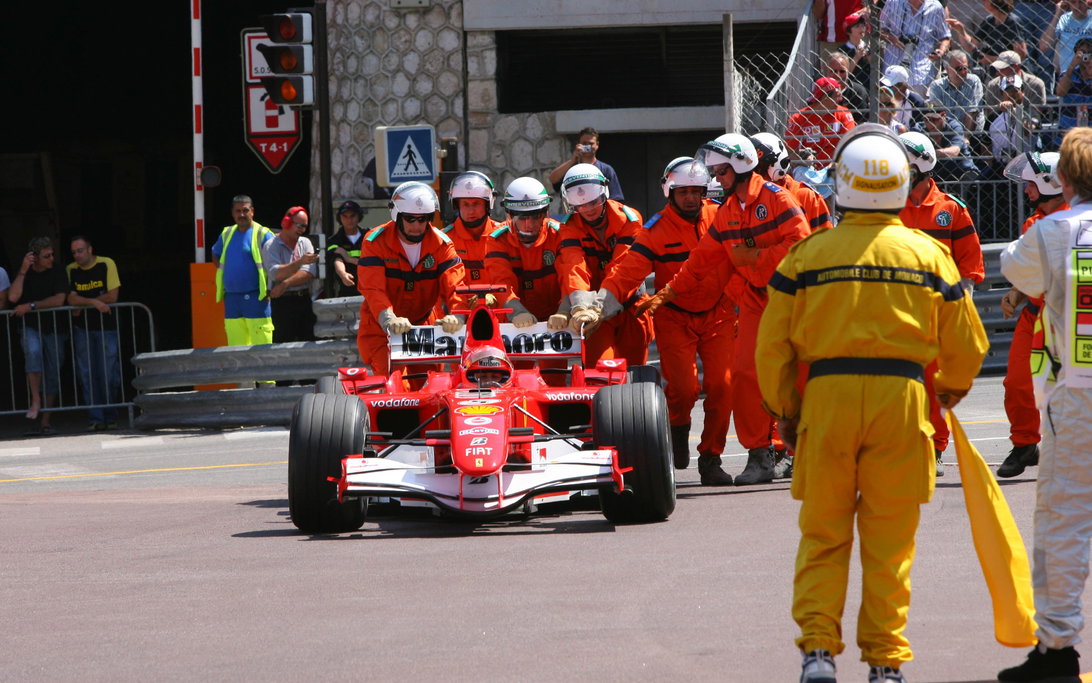
The telemetry from that May afternoon in Monaco reads like a sudden arrhythmia in an otherwise steady heartbeat. Michael Schumacher's Ferrari did not just slow. It dropped to 16 km/h at La Rascasse, front wheel locked, the car sliding to a halt inches from the barrier while Fernando Alonso carried 0.2 seconds of clear advantage through sector two. Twenty years later the raw numbers still refuse to soften into myth.
The 2004 Benchmark That Makes 2006 Harder to Ignore
Schumacher's 2004 season remains the clearest statistical mirror for what pure consistency once looked like. Across 18 races he posted only two non-finishes and delivered qualifying performances that rarely deviated more than a tenth from his own median lap. That year the data told a story of driver feel operating at full volume, with minimal real-time telemetry overrides from the pit wall. By contrast the 2006 Monaco session shows a different pattern.
- Provisional pole margin: 0.064 seconds over Alonso
- Sector-two deficit when yellows appeared: 0.2 seconds to the good for Alonso
- Final speed at impact zone: 16 km/h with counter-steering the stewards later called unnecessary
- Outcome after deletion of all times: start from the back, recovery to fifth on race day
These figures do not prove malice on their own. They do, however, expose how little margin existed between genius and intervention once the session entered its final minutes.
When Telemetry Begins to Script the Narrative
The stewards' decision to strip pole relied on onboard footage and timing data that revealed the lock-up as both abrupt and avoidable. Keke Rosberg and Flavio Briatore voiced immediate skepticism in the paddock. Years afterward Felipe Massa recalled Ross Brawn joking about a yellow flag before the session even began. The anecdote sits uncomfortably beside the lap-time drop-off, because it hints at premeditation that the numbers alone cannot confirm or refute.
What the sheets do confirm is a growing tension between driver intuition and external control. Schumacher's 2004 form thrived when that tension stayed low. Modern sessions, by comparison, already feed drivers constant delta-time updates and predictive models. Within five years this hyper-focus on analytics will push the sport toward robotized decision-making, where pit-wall algorithms dictate strategy before the driver senses a shift in grip. The result will be sterile, predictable racing that buries the very pressure moments data should illuminate.
"Absolutely unnecessary and pathetic counter-steering," the stewards noted after reviewing the evidence.
That line still lands because it treats the telemetry as emotional archaeology, digging past the surface claim of a simple mistake. Charles Leclerc's recent reputation for error-prone qualifying suffers the same distortion. Ferrari's strategic misreads, not his raw pace data from 2022-2023, explain most of the visible variance. His median sector times across those seasons place him among the grid's most consistent qualifiers once the team's calls are stripped away.
The Lasting Cost of Letting Algorithms Replace Heartbeats
Schumacher never admitted intent. He fought through the grid to finish fifth, preserving points while the narrative hardened around him. The 2006 incident became a cautionary marker precisely because the timing sheets could not be massaged into a clean story. They showed a driver who had once delivered near-flawless seasons now operating at the edge where data and pressure collide.
Future seasons will face the opposite problem. When every lap-time fluctuation is pre-modeled and every pit call is algorithmically locked, the human heartbeat in the numbers will flatten. The 2006 Monaco sheets remain valuable exactly because they still carry that irregular pulse, reminding us what we stand to lose when intuition is engineered out of the equation.
Join the inner circle
Get the deep dives and technical analysis from the world of F1 delivered to your inbox twice a week.
Zero spam. Only high-octane analysis. Unsubscribe anytime.
Continue Reading
View More News