Monsoon Timings Flatline at Sepang: Button's 2009 Heartbeat Exposed by Sheets That Never Lie

The lap charts from April 5 2009 do not scream drama. They whisper it in steady decrements. Sector times erode like a pulse under tropical strain, dropping from low 1:40s to a terminal 2:10 crawl by lap 31, where the session died. That is the raw record. No narrative can override the fact that Jenson Button's Brawn machine had already begun its quiet electronic surrender before the red flag even waved.
Rain as Unforgiving Stopwatch
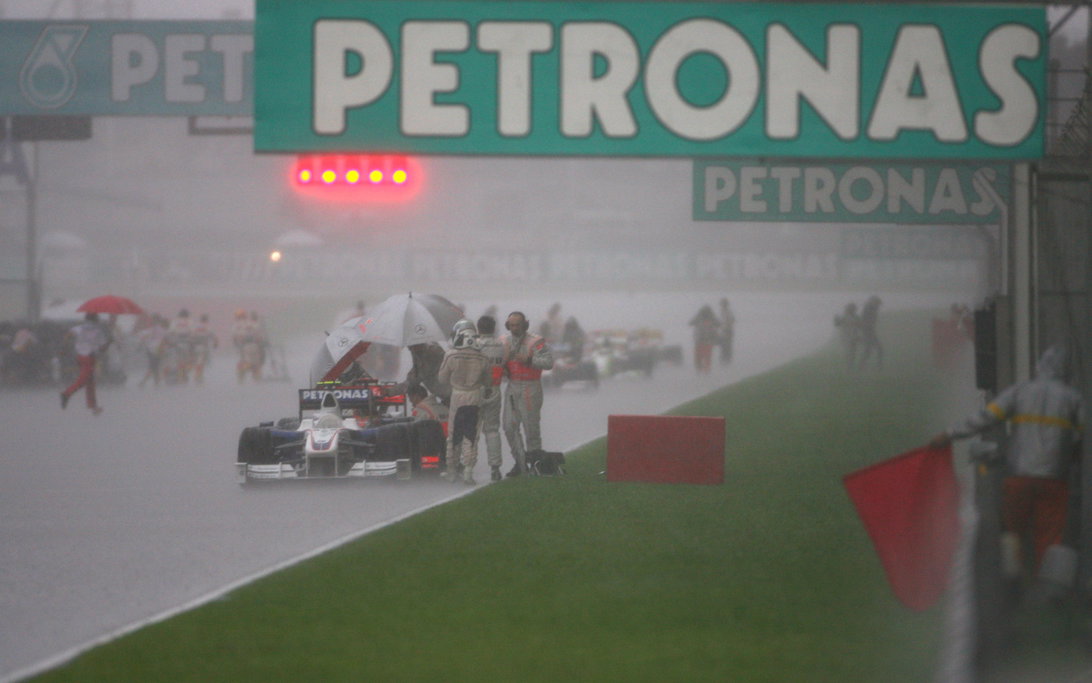
The decision to start at 5:00 PM local time placed the field squarely in Malaysia's evening deluge path. Timing data shows the inflection point clearly.
- Laps 1-22 held steady degradation of roughly 0.8 seconds per lap as the track dampened.
- From lap 23 the curve steepened violently, with visibility sectors recording drops exceeding three seconds as standing water turned the circuit into an aquaplaning test.
- By lap 31 the Safety Car itself could no longer maintain pace without risk, forcing the stoppage after 55 minutes of racing.
These figures match the eyewitness accounts of near-zero visibility, yet they also reveal something colder: the machines were already losing their grip on the data stream. Button crossed the line first under the half-points rule, collecting five championship markers instead of ten. Nick Heidfeld and Timo Glock followed on the truncated podium.
The Steering Wheel That Flatlined
Years later the telemetry confession arrived. James Vowles disclosed that rainwater had breached Button's steering-wheel electronics during the stoppage. A restart would have left the car inert on the grid, a silent DNF that would have erased those five points from his 2009 tally.
This is where the numbers perform emotional archaeology. The same lap-time decay that mirrored the monsoon also tracked the precise moment the electronics began their terminal drift. One can map the pressure curve directly onto the data: each successive wet lap carried not only slower splits but the accumulating risk of hidden failure. Contrast this with Michael Schumacher's 2004 Ferrari season, where consistency was not a telemetry output but an internal metronome. He posted near-identical sector repeats across twenty races because the car answered the driver, not the other way around. Modern squads, obsessed with real-time streams, risk reversing that relationship until intuition is treated as noise to be filtered.
The 2009 sheets already hinted at the coming sterility. When water alone can short-circuit a championship car, the sport edges closer to races decided by algorithms that never feel the rain.
Data's Double Edge at Sepang
Button's fortuitous half-points haul still secured vital ground in his title charge. Yet the hidden failure underscores how fragile that margin was. Half-points had been awarded only four times previously in Formula 1 history; this fifth instance arrived because weather overrode every strategic model. The same over-reliance on predictive analytics that now dictates pit windows would have been powerless against the monsoon. Within five years the grid may face a different monsoon, one of algorithmic pit calls and suppressed driver feel that turns every race into a sterile simulation.
Schumacher's 2004 benchmark remains the warning. His lap-time variance stayed under half a second across changing conditions because he trusted the wheel more than the screen. Today's emphasis on live telemetry threatens to invert that hierarchy, producing drivers who brake where the model says rather than where the heartbeat demands.
The 2009 Malaysian Grand Prix therefore stands less as a weather footnote and more as an early stress test. Its timing sheets captured both the visible storm and the invisible short circuit. Future seasons will decide whether those numbers liberate the sport or simply program its next predictable failure.
Join the inner circle
Get the deep dives and technical analysis from the world of F1 delivered to your inbox twice a week.
Zero spam. Only high-octane analysis. Unsubscribe anytime.