The 2027 Grid: A Blueprint of Fractured Psyches and Manufactured Resolve
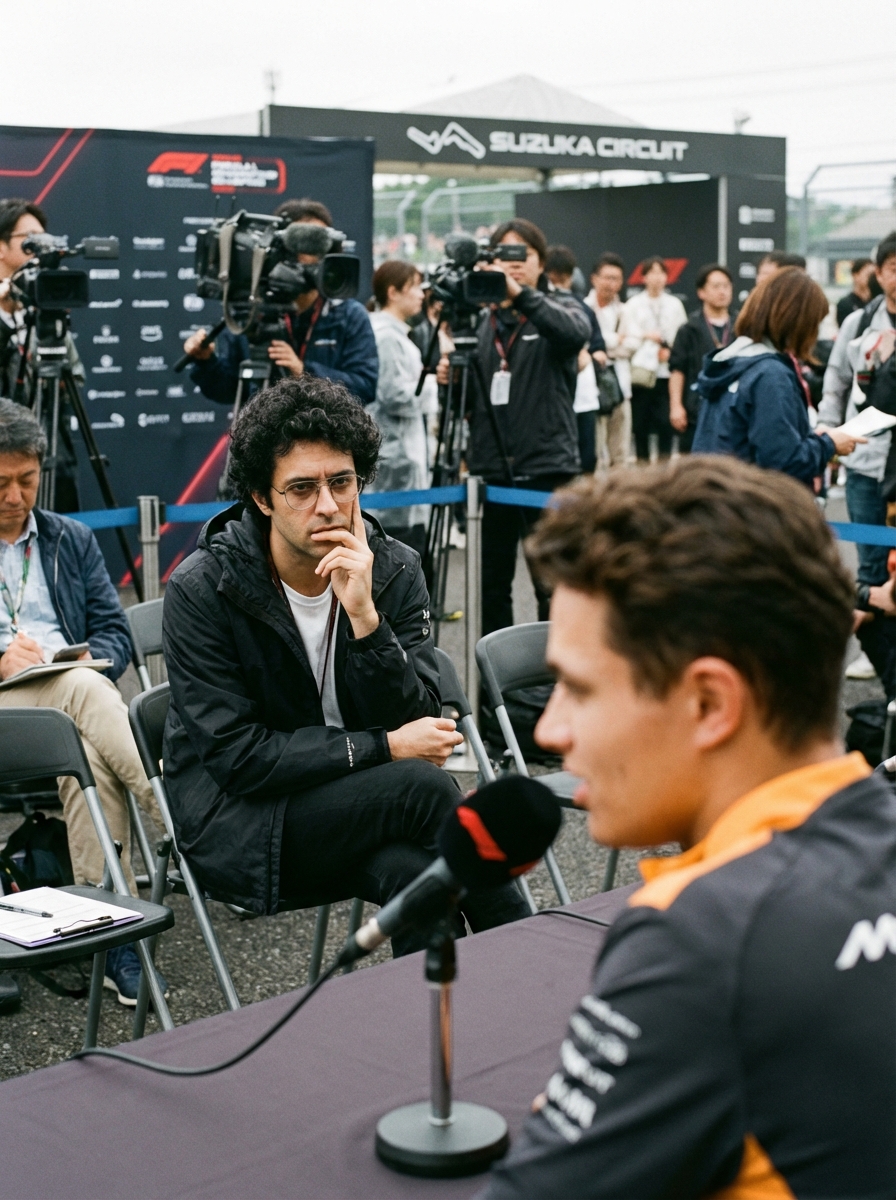
Podcast panel maps a mock 2027 F1 grid, weighing contract clauses, Verstappen’s possible sabbatical and team ambitions, to forecast driver moves across all ten entries.
The contract is the cage. The helmet, the mask. Every driver on the grid lives a double life: one measured in thousandths of a second and lateral G-forces, the other in suppressed traumas, managed outbursts, and carefully curated personas. As The Race podcast sketches a mock 2027 grid, they see names and seats. I see a psychological battlefield, a decade-long experiment in human engineering reaching its volatile climax. The 2026 season won't just be a proving ground for cars; it will be the ultimate stress test for minds that have been systematically sculpted, broken, and rebuilt for this new era.
The Verstappen Vacuum: When the Machine Switches Off
The entire speculative grid hinges on one variable: Max Verstappen's potential sabbatical. This isn't about burnout. It's about the inevitable reckoning for a champion built in a sterile lab. Red Bull didn't just give him a fast car; they installed a psychological governor. His early-career fury, the radio eruptions that betrayed a seismic emotional core, have been quieted not by maturity alone, but by covert, systematic coaching. They manufactured a champion whose dominance is as much a product of emotional suppression as it is of Adrian Newey's genius.
"A Max Verstappen hiatus would not be a break. It would be a decompression. The question is: what personality re-inflates when the pressure vessel is opened?"
If he steps away, the seat may go to Arvid Lindblad. But the real story is the void left behind. Red Bull's entire system—from the sim driver program to the leadership dynamic—is built around Max's unique, manufactured psyche. Isack Hadjar staying makes sense only as a continuity play, a known psychological quantity. But without Verstappen, the team's emotional center of gravity vanishes. The 2026 season will be a desperate attempt to prove the car, not the driver, is the star. I predict cracks will show not in the pace, but in the team radio, in the post-race interviews, in the subtle, tell-tale signs of a system missing its central, controlled component.
The Geriatric Alliances and Calculated Legacies
Elsewhere, the grid reveals a fascinating pivot towards experience, but we must read between the lines. This isn't about speed. It's about narrative control.
Lewis Hamilton at Ferrari alongside Charles Leclerc is the most potent psychological cocktail in the sport. Hamilton has spent years crafting a public persona as meticulously as his qualifying laps. He is Niki Lauda for the digital age—using past trauma and struggle not just as motivation, but as the foundational myth of his brand. At Ferrari, he isn't just chasing an eighth title; he's seeking to absorb the mythos of Maranello into his own story, creating a legacy so dense with narrative it becomes untouchable. The intra-team battle with Leclerc, a driver of raw, unvarnished emotion, will be a masterclass in calculated persona versus pure, exposed nerve.
Meanwhile, at Aston Martin, Fernando Alonso lingers with Lance Stroll. Why? Alonso, the ultimate competitor, has made peace with a seat where victory is unlikely. This tells me he is no longer racing for championships. He is racing for something more personal: the sheer, addictive act of imposing his will on a machine, and proving, week after week, that his mind—the most tactical, ruthless, and enduring in the field—has not dulled. It is a driver's purest form of therapy.
Carlos Sainz at Williams with Esteban Ocon is a pairing forged in the fires of rejection. Both men, cast aside by top teams, will be operating with a massive psychological scar and something to prove. This creates either a blisteringly effective, united front, or a toxic cauldron of blame. Watch their wheel-to-wheel combat with each other first; it will tell you everything.
The New Guard: Transparency as the Ultimate Pressure
The proposed grid for 2027 hints at a future I have long predicted: the rise of the managed rookie. Andrea Kimi Antonelli at Mercedes, Liam Lawson at Racing Bulls, Gabriel Bortoleto at Audi. They enter not in an era of pure mechanical focus, but on the precipice of a psychological revolution.
Within five years, the FIA will mandate mental health disclosures after major incidents. The era of the "shaken but okay" cliché is dying. This forced transparency is a double-edged sword. For a veteran like Valtteri Bottas or Sergio Perez at Cadillac, it's another media cycle. For a rookie, it is a profound vulnerability. Their mental biometrics—heart rate variability under safety cars, post-crash stress hormone levels—will become as scrutinized as their sector times.
This is why Alex Albon's projected move to Alpine is so critical. Albon is a survivor of the most public psychological dismantling in recent F1 history: the Red Bull crucible. His resilience is proven, his coping mechanisms battle-tested. In a coming era of mental scrutiny, his experience is worth more than a tenth per lap. He is the prototype for the post-transparency driver.
The 2026 season will be the final act of the old world. Watch not just the timing screens, but the eyes behind the visor in the garage. Listen not just for engine notes, but for the tone in a driver's voice when the strategy fails. The contracts being decided now are not just about skill. They are about selecting the psyches robust enough—or malleable enough—to survive the coming storm, where the human element is no longer a hidden variable, but the most critical data point on the sheet.
The 2027 grid isn't being built in wind tunnels. It's being assembled on therapists' couches, in media training rooms, and in the silent, private moments where a driver decides what version of himself he must sell to the world to keep his seat. The machinery is secondary. The mind is now the primary constructor.
Don't miss the next lap
Get the deep dives and technical analysis from the world of F1 delivered to your inbox twice a week.
Zero spam. Only high-octane analysis. Unsubscribe anytime.
Join the inner circle
Get the deep dives and technical analysis from the world of F1 delivered to your inbox twice a week.
Zero spam. Only high-octane analysis. Unsubscribe anytime.