Gary Anderson: Mercedes' radical Monaco winglets could be the cheapest two-tenths per lap
Mercedes' innovative rear-wing actuator winglets in Monaco deliver up to two-tenths per lap, according to Gary Anderson's technical analysis. The cheap 3D-printed parts exploit a regulatory loophole to generate extra downforce at a critical track.
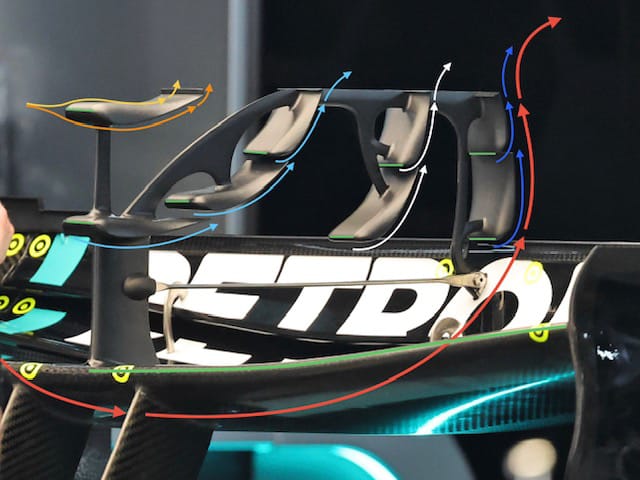
Monaco always inspires creative aero solutions, and this year's sprouting of winglets on the rear-wing active aero actuators is no exception. Gary Anderson breaks down the most impressive design – Mercedes' intricate cascade of small elements – and estimates it could be worth two-tenths of a second per lap, at a manufacturing cost of just £250-500 per unit.
Why it matters:
At a track where every thousandth of a second counts and mechanical grip is king, any free downforce is gold. These winglets work in conjunction with the main rear wing and central diffuser to stabilize the rear end under braking, a critical advantage around Monaco's tight corners. If the gain holds, it's the cheapest performance upgrade a team can bring all season.
The details:
- The regulations allow a small fairing area around the actuator on the car's centreline, above normal wing height. Teams are using this space for tiny aero appendages.
- Mercedes' cascade: Anderson identifies four assemblies – a top forward element, a three-element second assembly, a two-element third, and a rear two-element component. Each has a small Gurney flap at the trailing edge to keep flow attached.
- The red flow path under the main rear wing plane aims to optimize pressure consistency across the entire wing undersurface, not just the central section.
- Cost vs benefit: Once optimized in CFD and 3D-printed, each unit costs £250-500. A few kilograms of extra rear downforce improves braking stability. Anderson suggests the total gain is upwards of 0.2s per lap – a phenomenal return on investment.
- Others are playing down: Most teams have similar but smaller-scale versions. Anderson notes that their downplaying likely reflects their own more modest gains, while Mercedes' design has the biggest potential.
Between the lines:
The winglets are a reminder that F1 engineers never stop exploring the regulation's grey areas. Monaco's unique low-efficiency demands allow teams to dream – and Mercedes has turned that dream into a tangible, cheap speed boost. Whether this solution appears at other circuits remains to be seen, as the efficiency penalty of extra drag might outweigh the downforce gain elsewhere.
Don't miss the next lap
Get the deep dives and technical analysis from the world of F1 delivered to your inbox twice a week.
Zero spam. Only high-octane analysis. Unsubscribe anytime.
Join the inner circle
Get the deep dives and technical analysis from the world of F1 delivered to your inbox twice a week.
Zero spam. Only high-octane analysis. Unsubscribe anytime.
Continue Reading
View More News