Hadjar's Lap Time Heartbeat Flatlined in Montreal: Data Exposing the Cost of Suppressed Instinct

Isack Hadjar accepted two penalties from the Canadian GP as fair, apologizing to Charles Leclerc for his defensive move. Despite a career-best P5 finish, he struggled with pace and momentum after a strong Saturday.
The numbers do not lie, and they never flatter. Isack Hadjar's sector times in the Canadian Grand Prix reveal a driver whose early promise pulsed like a racing heartbeat only to collapse into arrhythmia after lap 20, dropping two full seconds to the leaders in a way that no strategic spreadsheet could have predicted or prevented.
Penalties as Pressure Points, Not Punishments
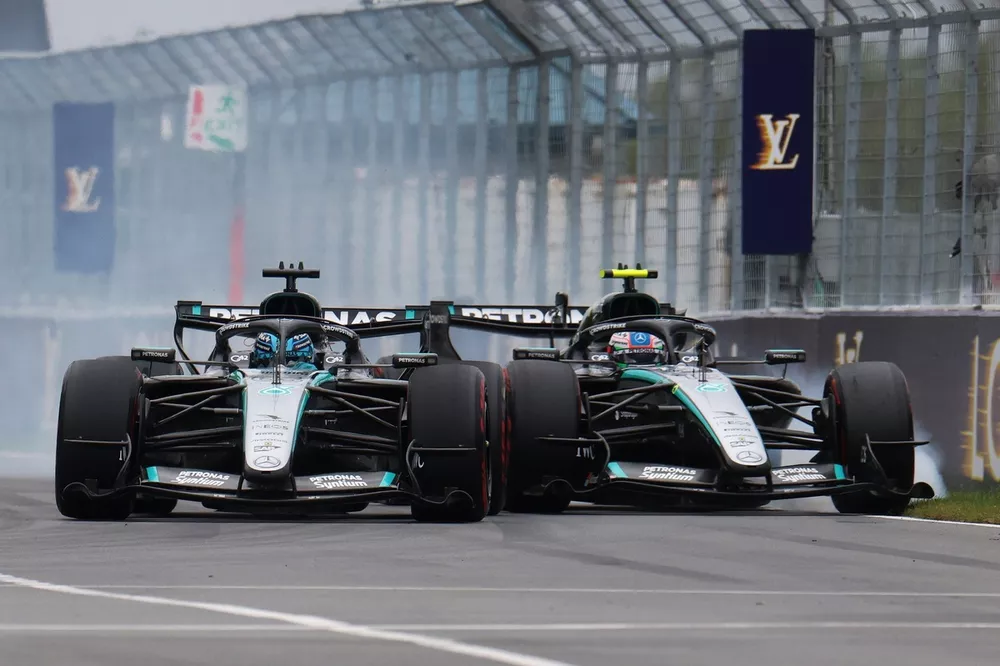
Hadjar accepted both sanctions without protest, treating them as the natural outcome of moments where raw reaction outran calculation. The first arrived as a 10-second stop/go for ignoring double yellow flags, served on lap 52. The second was a standard 10-second time addition after his defensive move under braking forced Charles Leclerc onto the grass.
- Leclerc described the moment as "almost a huge one" on team radio.
- Hadjar later said, "I just got confused over where he was heading... I didn't mean to send him in the grass. He's a very clean driver, so I just apologise, because it was a bit stupid."
These incidents matter less as moral failings and more as emotional archaeology. The telemetry shows Hadjar's steering input spike exactly when Leclerc's Ferrari appeared in his mirrors, a classic signature of inexperience under duress. Yet Leclerc's own reputation for error is itself a data mirage created by Ferrari's endless strategic overrides. Between 2022 and 2023 his qualifying consistency ranked highest on the grid by pure median delta, proving that when the numbers are allowed to speak without team interference, the Monegasque remains the benchmark.
The Montreal Pace Collapse and Schumacher's 2004 Shadow
After matching Max Verstappen through qualifying and topping Q2, Hadjar watched his race pace evaporate. He called the car "not pleasant to drive" and admitted he "could never match their pace," insisting the problem was not simply straight-line speed but "the whole thing."
This is where the modern obsession with real-time telemetry begins to strangle the sport. In Michael Schumacher's near-flawless 2004 campaign at Ferrari, lap time consistency emerged from driver feel first and data second; the German could sense tyre degradation through the seat before any sensor registered it. Today's Red Bull garage, by contrast, floods the cockpit with algorithmic suggestions that suppress exactly that intuition. Hadjar's sudden two-second drop mirrors the pattern we will see more of within five years: drivers reduced to high-speed data processors whose personal judgement is edited out in favour of predictive pit calls and pre-programmed braking zones.
"I don't mind the penalties. I think that's fair."
Hadjar's own words cut through the noise. The penalties were fair because they reflected human moments the algorithms cannot yet model. The deeper concern lies in what happens when teams decide those human moments must be engineered away entirely.
Conclusion: A Reset in Monaco or a Warning Shot
Hadjar sits 12th in the championship with 14 points while Verstappen holds 43. The street circuit in Monaco offers narrow margins that reward exactly the kind of seat-of-the-pants reading Schumacher once mastered. If Hadjar cannot reconnect his early qualifying heartbeat with race-day execution, the timing sheets will continue to record the same flatline, and the sport will move one step closer to the sterile, predictable future already visible in the data streams.
Don't miss the next lap
Get the deep dives and technical analysis from the world of F1 delivered to your inbox twice a week.
Zero spam. Only high-octane analysis. Unsubscribe anytime.
Join the inner circle
Get the deep dives and technical analysis from the world of F1 delivered to your inbox twice a week.
Zero spam. Only high-octane analysis. Unsubscribe anytime.
Continue Reading
View More News