The Ghost in the Machine: How 2026's Energy Harvesting is Creating Monsters in F1's Sacred Corners

You can feel it in the paddock whisper network, a low hum of anxiety that has nothing to do with engine maps and everything to do with survival. We talk of marginal gains, of millisecond advantages, but David Coulthard has just pointed a trembling finger at a spectre we’ve all seen in the data but dared not name. The 2026 regulations aren’t just changing the game; they’re planting invisible landmines on the sport’s most hallowed ground. At Eau Rouge. At Suzuka’s 130R. Places where men are made and legends are buried. This isn’t evolution; it’s a dangerous game of digital chicken, and the drivers are the only ones without a controller.
When the Car Becomes a Capricious Spirit
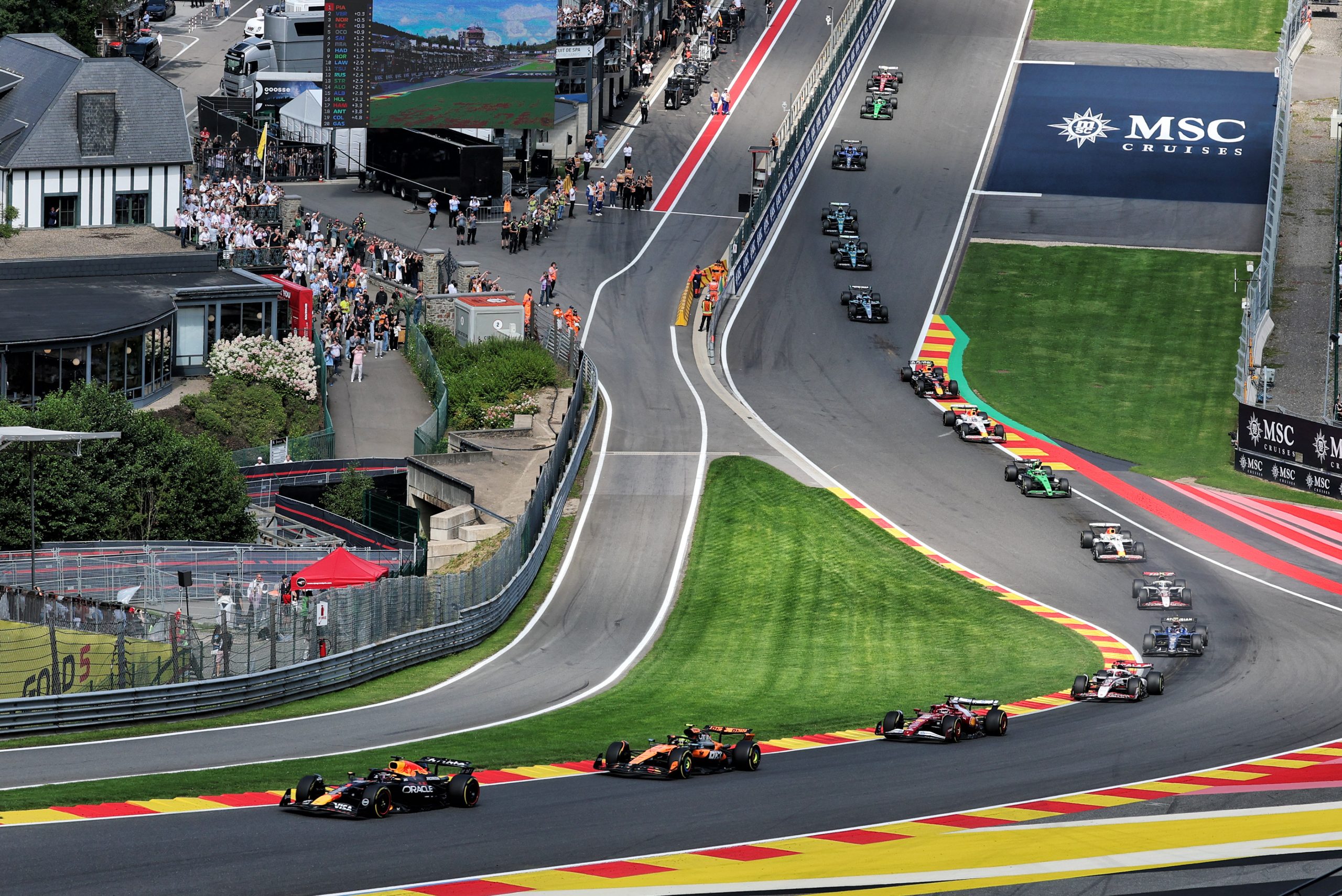
Let’s strip away the PR speak. The 2026 hybrid rule is simple: harvest kinetic energy in any corner, deploy it later. The engineering intent is pure. The real-world effect is a form of Russian roulette. A car ahead, sluggish through Eau Rouge as its MGU-K gorges on energy, can suddenly transform into a rocket ship over the crest. The 30–40 mph speed differential Coulthard cites isn’t a statistic; it’s a death sentence in a blind corner. There is no reaction time. There is only impact.
"You're driving on faith, and faith has no place at 200 mph," a driver, who demanded I not use his name, told me over a tense coffee. "It's like the car ahead has a secret button you don't. One moment it's there, the next it's vanished. You're left wrestling a physics equation that changed halfway through."
The Suzuka incident with Oliver Bearman wasn't bad luck. It was a preview. A slower car, harvesting, then deploying, creating a vortex of unpredictable air and a closing speed Bearman couldn't compute. He spun. Next time, it could be a carbon fibre shower. The FIA’s tinkering with qualifying limits is like applying a bandage to a severed artery. Coulthard’s call for exempting high-speed sections isn’t just sensible; it’s the bare minimum to prevent a tragedy that would shake the sport to its core.
The Real Cost: Eroding the Warrior's Code
This touches on something fundamental I’ve argued for years: the psychological contract between driver and machine. Modern F1 already coddles the mind with a thousand assists. Now, we’re adding unpredictable performance variance. How do you profile a driver’s aggression, his risk calculus, when the car’s capability isn’t a constant but a variable hidden behind another team’s software strategy?
Think of Charles Leclerc at Ferrari. His so-called "consistency issues" are magnified tenfold in an environment like this. Is he pushing too hard, or is he a victim of a car that suddenly, silently shifts its personality mid-corner based on a battery’s whim? In Maranello, where veteran intuition often overrules cold data, how would they even diagnose such a ghost in the machine? They’d likely blame the driver’s spirit before the software’s logic. It’s a recipe for destroying confidence, for turning artists into accountants who are scared to settle a debt.
A Symptom of a Bigger Sickness
Don’t mistake this for a simple safety plea. Coulthard has unwittingly exposed the foundational crack in modern F1’s facade. We are governed by a philosophy of relentless technological intrusion, justified by "green" credentials and "road relevance," while the core spectacle—man versus circuit at the limit—is being outsourced to an algorithm.
This is the same short-term thinking that will lead, mark my words, to a major team collapse within five years. The budget cap is a sieve, not a dam. Teams are pouring millions into software like this, finding loopholes in "non-financial" R&D, creating systems so complex they become opaque even to their own strategists. The unsustainable strain isn’t just financial; it’s intellectual. We’re building monsters we can’t fully control, and when the inevitable catastrophic failure happens—be it on track or on a balance sheet—the finger-pointing will make the 1989 Prost-Senna wars look like a tea party. At least those conflicts had genuine, human stakes. Today’s radio dramas are puppets shouting at shadows cast by their own engineering departments.
The Thai Tale of the Naga and the River
This reminds me of an old tale from the Mekong. A village tried to harness the river’s power by building a complex series of gates and channels. They succeeded, but in doing so, they angered the Naga, the great serpent spirit of the water. The river’s flow became unpredictable, surging where it was once calm, drying up where it was needed. They controlled the water, but lost the river.
The FIA and the teams are those engineers. In their zeal to harvest every joule, to mandate complexity, they are angering the very spirit of the sport—the pure, visceral challenge of the circuit. Eau Rouge is our Naga. It is a living, breathing challenge that has defined generations. To turn it into a mere energy recovery zone is a profound disrespect. It is to lose the river for the sake of a cup of water.
Conclusion: Reclaiming the Edge
The FIA’s promise to "keep reviewing" is bureaucratic cowardice. A corner-specific exemption isn’t a compromise; it’s a necessity. But we must go further. We need a philosophical reset.
We must ask: what are we optimizing for? Is it for the most efficient recovery of energy, or for the greatest test of driver skill? The two are now in direct conflict. Coulthard, the seasoned veteran, is pleading for the latter. He’s asking for a sanctuary where the "edge of adhesion" is felt through the seat of the pants, not calculated by a sensor and withheld by a battery.
The solution is not more technology. It is less. It is drawing a line on the map and saying, here, you are a driver, not a systems manager. Protect these corners. Preserve these challenges. Because if we don’t, the next great rivalry won’t be between Hamilton and Verstappen, or Leclerc and Piastri. It will be between every driver on the grid and the ghost in their own machine. And in that battle, we all lose.
Join the inner circle
Get the deep dives and technical analysis from the world of F1 delivered to your inbox twice a week.
Zero spam. Only high-octane analysis. Unsubscribe anytime.
Continue Reading
View More News