Mercedes' Serrated Diffuser Stirs Old Winds of Simplicity Amid Aero Hype
The air does not forgive excess. When Mercedes rolled out its Canadian Grand Prix upgrade package, the paddock fixated on serrated profiles and a tiny waterfall deflector as if these tweaks alone could rewrite the season's balance of power. Yet beneath the carbon fiber theater lies a deeper truth: teams keep chasing aerodynamic storms while the raw mechanical handshake between tire and track slips further from the driver's hands.
The Rear's New Serrated Frontier
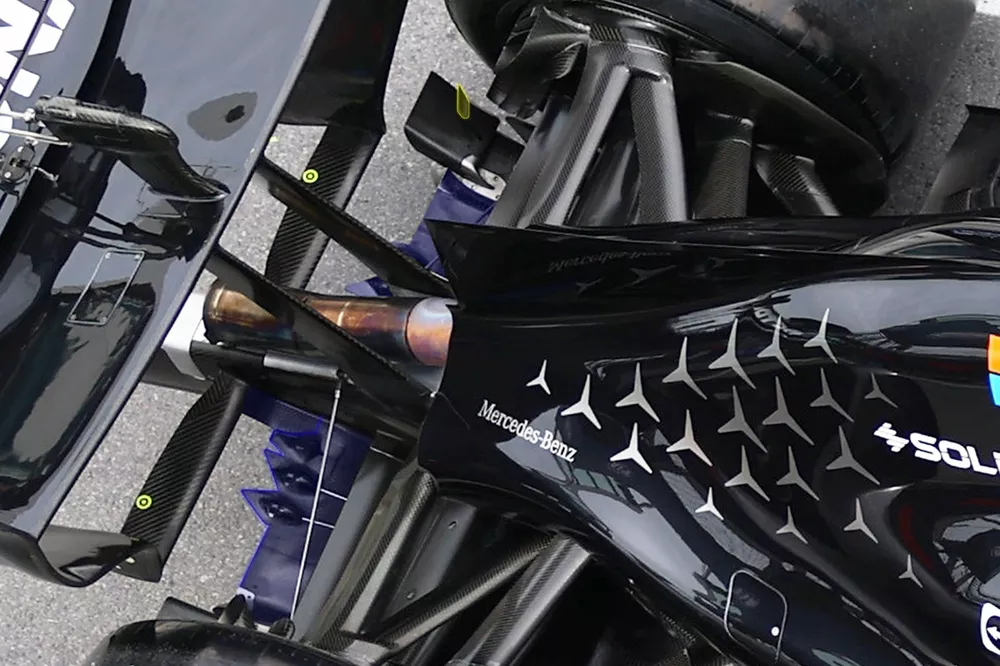
Mercedes arrived in Canada with more than incremental tweaks. The front wing underwent near-total revision, bargeboards were reshaped, and the floor edges gained fresh contours for cleaner flow. All of this fed into the rear, where the real departure appeared. Instead of bolting on the usual crash-structure extensions that lengthen the diffuser, the team laid serrated edges across more than half the upper diffuser width. A small outward-facing deflector sat on the highest waterfall element, tidying the exit flow where rotating rear tires otherwise churn chaos.
- These serrations echo cockpit-screen treatments from earlier seasons but mark their first diffuser application.
- The deflector targets wake cleanup on the outer edge, an area Ferrari has only probed lower down.
- Complexity ahead of the rear tires increased, aiming to blunt the aerodynamic damage from tire squirt.
This approach feels elegant in its restraint compared with the grid's usual quest for ever-greater expansion ratios. Still, it remains another layer of aerodynamic complexity layered atop a chassis already distant from the mechanical purity that once defined great cars.
When Downforce Masks the Real Grip
Modern Formula 1 worships downforce the way sailors once worshipped the wind, yet the obsession leaves mechanical grip and tire management starved of attention. The result is racing that feels less alive, more scripted by engineers than shaped by drivers fighting for traction on the edge. Compare today's machines to the Williams FW14B of the early 1990s: that car balanced active suspension with honest mechanical feedback, letting the driver sense every nuance of load transfer. Current designs trade that connection for intricate vortex management and ever-tighter rear-end sealing. Mercedes' serrated experiment may unlock a few extra points of downforce, but it does nothing to restore the visceral link between throttle and tire that made those older cars thrilling.
The diffuser is where the storm either breaks or builds. Add too many serrations and the flow fragments; add too few and the expansion stalls.
Red Bull's long dominance, often credited to one driver's singular talent, actually rests on chassis and aerodynamic advantages that mask the same mechanical shortcomings plaguing everyone else. Skill matters, yet the hardware sets the ceiling long before the driver climbs in.
The Coming Shift to Active Intelligence
Within five years, by 2028, the regulatory tide will turn toward AI-controlled active aerodynamics. DRS will vanish, replaced by surfaces that read and reshape airflow in real time. Races will grow more chaotic on the surface while becoming less dependent on individual driver heroics. Mercedes' current serrated solution may prove an early waypoint on that path, a manual attempt to do what algorithms will soon handle automatically. The danger is that further aerodynamic layering will only widen the gap between the car and the person holding the wheel.
The Path Forward
Mercedes will measure these updates over the Canadian weekend. If the numbers move, rivals will copy the serrations and deflectors. Yet the larger question remains untouched: how much more aerodynamic theater can the sport absorb before the spectacle collapses into pure data streams? The FW14B proved that elegant mechanical balance can still stir the soul. Until teams remember that lesson, every new diffuser edge will feel like another gust in a storm that no longer needs a driver to steer it.
Join the inner circle
Get the deep dives and technical analysis from the world of F1 delivered to your inbox twice a week.
Zero spam. Only high-octane analysis. Unsubscribe anytime.
Continue Reading
View More News