Mercedes' Front Wing Sleight of Hand Reveals the Empty Promise of Modern Aero Wizardry
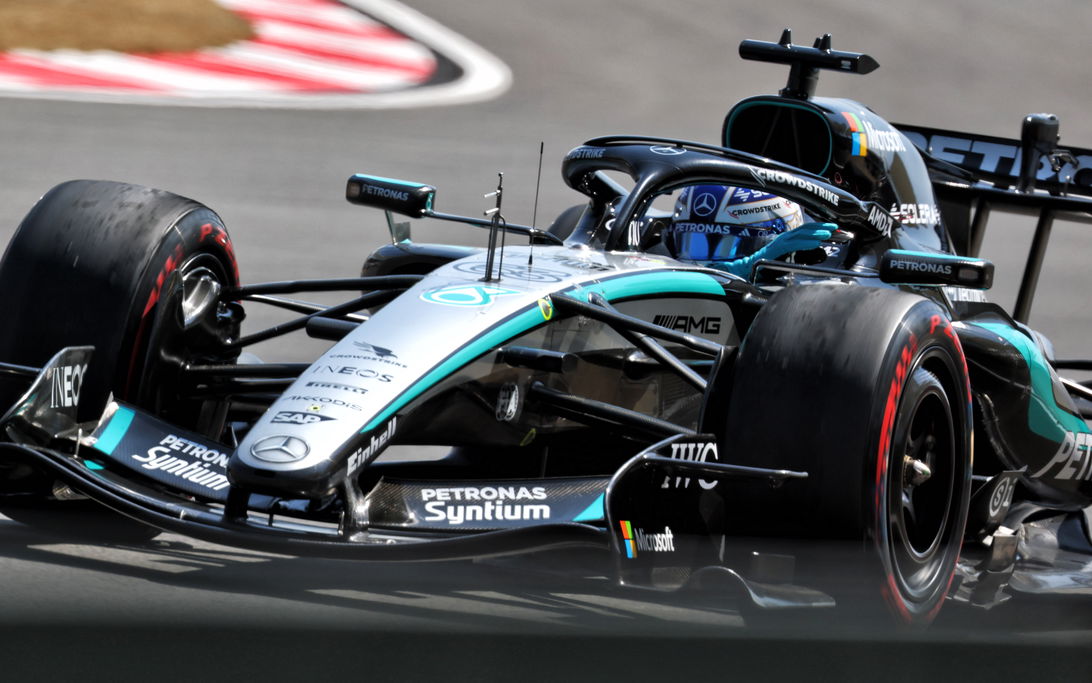
The front wing on the Mercedes W15 does not simply bend the rules. It exposes how today's cars have drifted into a storm of their own making, where every flap twitch promises control yet delivers less genuine connection between tire and tarmac than the Williams FW14B offered three decades ago. While rivals chase milliseconds of downforce, Mercedes appears to be slowing the return of that force on purpose, turning a regulatory gray zone into a tool for steadier braking and smarter energy harvest. This is not genius; it is the predictable result of a sport that forgot mechanical grip matters more than any active surface.
The Slow Close That Changes Everything
The 2024 rules demand the front wing flap return to its standard position inside 400 milliseconds once overtake mode ends. Mercedes, by all technical accounts, reaches only the halfway mark in that window and lets the full sequence stretch to roughly 850 milliseconds. That extra time is not wasted. It spreads the reappearance of front downforce across a longer moment, so the nose does not suddenly plant itself and shove weight rearward in one violent lurch.
- Reduced pitch under braking keeps the tire contact patches more consistent.
- Drivers can trail the brakes deeper without the car snapping into oversteer.
- Less aggressive engine braking preserves rear grip and feeds the ERS more cleanly on corner exit.
Think of it as letting a gust ease rather than slamming a door against the wind. The car feels calmer, the driver more confident, and the lap time ticks lower without any extra horsepower. Yet the real story is what this reveals about priorities. We keep adding layers of aero complication when the FW14B proved that a well-sorted mechanical package could deliver grip through the tires alone, not through constant electronic fiddling.
From Human Feel to Algorithmic Drift
Active aerodynamics was sold as a way to make racing safer and more exciting. In practice it pulls the driver one step further from the raw forces at the contact patch. Mercedes' interpretation simply accelerates that trend. A slower wing closure smooths the storm at the front axle, but it also masks the very sensations that once let drivers like those in the 1990s sense grip limits through their hands and hips. By 2028 the sport will likely hand those decisions to AI controllers anyway, removing DRS and human timing altogether. Races may become more chaotic on paper, yet they will feel less human because the car will decide its own balance before the driver even reacts.
This is why tire management and mechanical grip remain the most undervalued skills in the paddock. Downforce numbers look impressive on a screen, but they hide how little the driver actually contributes once every surface is moving. Mercedes has found an elegant way to exploit the current wording, yet the solution still lives inside the same flawed philosophy that values aerodynamic complexity over honest chassis feedback.
The regulations speak of movement completed, not position reached. That single ambiguity has become a performance lever.
Rival teams will study the data and decide whether to copy or protest. The FIA may issue a clarification. Either way the deeper problem stays untouched: we keep engineering away the very unpredictability that once made grand prix racing thrilling.
Where This Path Actually Leads
If Mercedes keeps the concept and others follow, expect more cars to treat the 400-millisecond rule as a suggestion rather than a hard stop. Braking stability will improve, ERS deployment will look smoother, and lap times will drop. None of that addresses the core issue that these cars already ask too little of the person behind the wheel. The FW14B could dance on the edge because its suspension and tires did the talking. Today's machines drown that conversation in a constant aerodynamic murmur.
The loophole is clever. It is also a symptom. Until Formula 1 remembers that real speed begins where the rubber meets the road, not where a flap decides to settle, these technical battles will remain sophisticated distractions rather than genuine progress.
Join the inner circle
Get the deep dives and technical analysis from the world of F1 delivered to your inbox twice a week.
Zero spam. Only high-octane analysis. Unsubscribe anytime.