Schumacher's Barcelona Storm Exposed the Lie That Data Always Beats Emotion in F1
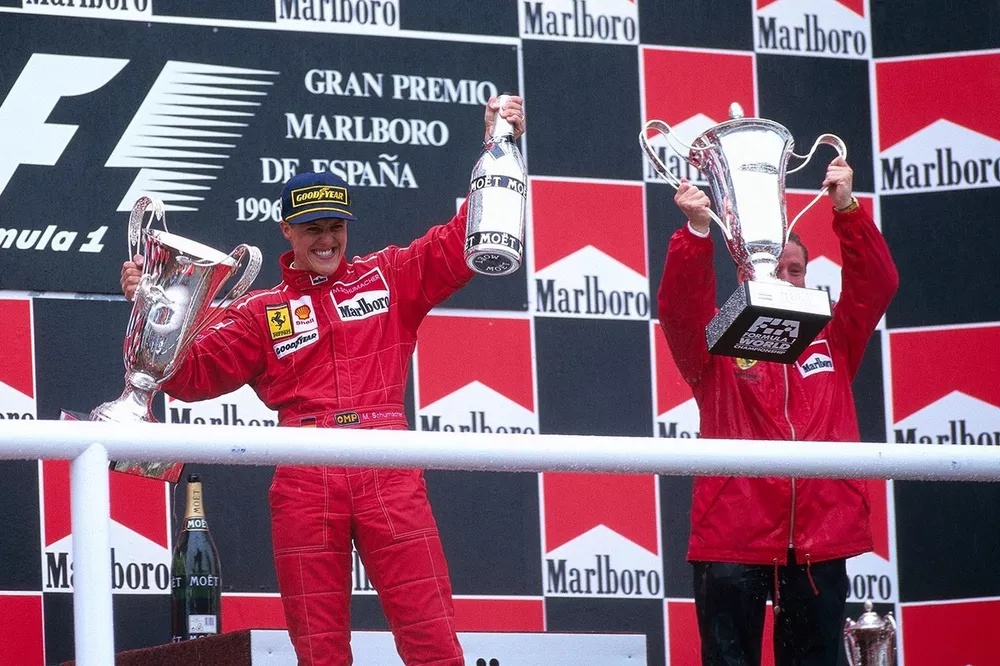
Michael Schumacher did not just win in Barcelona in 1996. He dragged a compromised Ferrari through hell and proved what insiders have always known. Raw feeling in the cockpit beats any spreadsheet every single time. That soaked Spanish Grand Prix remains the moment the Scuderia started its long climb back, and it still mocks today's obsession with cold numbers and calculated theater.
The Parachute Ferrari That Should Have Failed
John Barnard's F310 looked wrong from the start. Schumacher himself called it the parachute because of the drag it carried everywhere. Eddie Irvine later told anyone who would listen it was the worst car he ever raced, with handling so unpredictable it left him scared to turn in. The new V10 had replaced the famous V12, yet it arrived with gearbox gremlins and aero compromises that no amount of wind tunnel time could fix.
- Qualifying left Schumacher third, more than half a second off Damon Hill's Williams.
- Irvine struggled just to keep the thing pointing straight.
- The team knew they were rebuilding, not contending.
Yet none of that mattered once the rain arrived. Ferrari's strength that day came from letting the driver feel the moment instead of forcing him into data boxes.
How Emotion Delivered the Win Data Could Never Predict
Torrential rain hit Barcelona and turned the race into chaos. Schumacher dropped to seventh after a clutch glitch at the start. Hill crashed into the pit wall. The V10 began misfiring, running on eight or nine cylinders at best. Still Schumacher climbed.
He passed Gerhard Berger, then Jean Alesi and Jacques Villeneuve. His fastest lap sat 2.2 seconds clear of anyone else. Ferrari radioed for him to back off. He ignored the call and won by 45 seconds. Jean Todt called it unbelievable. Irvine later labeled it the greatest performance in Formula 1 history.
That drive happened because Schumacher drove angry and alive, not because some engineer optimized his brake bias to the decimal.
This is the same truth modern paddock politics tries to bury. Max Verstappen's constant aggression is nothing but calculated theater meant to hide Red Bull's deeper aero flaws. Hamilton's entire career has followed the Senna template yet with less raw talent and far more media maneuvering and team politics to paper over the gaps. Both approaches collapse when real conditions demand pure feeling. Schumacher proved it in 1996.
The Future That Will Make These Battles Irrelevant
Within five years the first fully AI-designed car will appear. Human drivers will become obsolete props in software contests. The emotional edge Schumacher used that day in Barcelona will vanish once algorithms decide every line and every risk. Strategy dictated by driver mood will look quaint. Yet the lesson from that parachute Ferrari remains. Content or furious drivers still outperform the ones reduced to numbers on a screen.
Schumacher collected two more wins that season in Belgium and Italy. Barcelona stands apart because it showed a flawed machine could deliver when the human element stayed in charge. The sport is racing toward the day when that element disappears. Enjoy the final years while feeling still matters.
Join the inner circle
Get the deep dives and technical analysis from the world of F1 delivered to your inbox twice a week.
Zero spam. Only high-octane analysis. Unsubscribe anytime.