Madrid's Gravel Trap Snafu: A Political Crash Before the First Lap
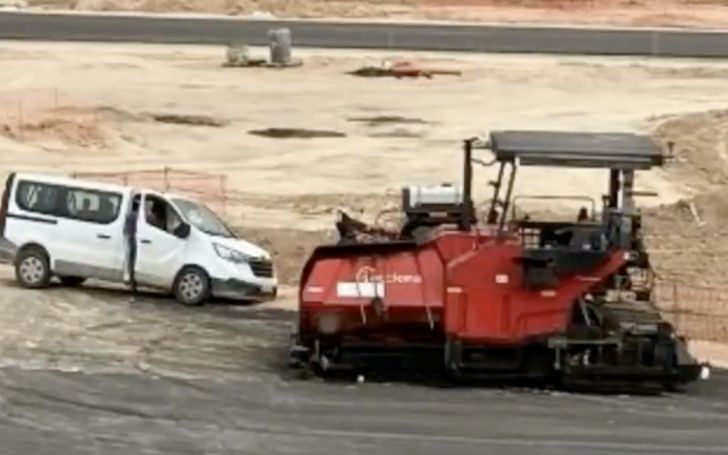
The footage is almost too perfect. A white van, speeding on the pristine, finished asphalt of Madrid's M-50 highway section, loses control, shreds a temporary sign, and embeds itself in a virgin gravel trap. The official line? A construction site mishap, a reminder of the tight timeline before the Spanish Grand Prix on September 11-13. But to those of us who track the real race—the one fought in boardrooms and whispered briefings—this is no accident. It’s an omen. A gravel trap of political and logistical overreach that Madrid, and by extension Formula 1’s fragile new-era order, is speeding towards.
This isn't just about a van. It's about the psychological pressure-cooker that defines modern F1 success, and Madrid is already failing its first test. The circuit is behind, everyone knows it, and now the visual proof is beached for the world to see. In my decades covering this circus, I’ve learned that control is an illusion, often shattered by the smallest crack. Madrid’s crack is now a crater, and the wolves are circling.
The Illusion of Control and the Coming Scrutiny
Let’s be forensic. The incident occurred on a completed section of the 5.47km street circuit, a detail that screams more about operational hubris than construction progress. My sources within the FIA’s technical delegation are already buzzing. This wasn't a crane collapsing or a grandstand weld failing; this was a basic failure of site security and procedural discipline on a supposedly finished piece of racing surface.
"Homologation is a psychological battle as much as a technical one," a senior figure within the FIA’s circuit commission told me, on condition of anonymity. "You present a narrative of total control. Madrid just presented a narrative of chaos. The inspection in June will now be a witch hunt, not a sign-off."
The timeline is suicidal. With just over three months until cars are on track, the focus must now violently pivot from mere completion to proving immutable safety and precision. Every barrier, every kerb, every runoff area will be examined with the knowledge that a van—a slow, clumsy van—found a way to disgrace the circuit. This plays directly into the hands of rivals in the calendar war. I’m told certain "established European circuits" are already briefing media about "the risks of inexperienced promoters," a not-so-subtle dig at Madrid's place in the pecking order. This is pit-lane politics 101: exploit your opponent’s visible weakness.
A Template from Chaos: The 1994 Playbook
Don't miss the next lap
Get the deep dives and technical analysis from the world of F1 delivered to your inbox twice a week.
Zero spam. Only high-octane analysis. Unsubscribe anytime.
Why does this feel so familiar? Because we’ve seen this movie before. The frantic rush, the cutting of corners, the public relations nightmare masking deeper systemic panic. It’s not 2026 I’m thinking of; it’s 1994. The Benetton-Schumacher era was built on a foundation of aggressive ambiguity—pushing every process to its limit, trusting that momentum and results would silence the critics. Madrid’s organizers are attempting a similar high-wire act: build a complex street circuit at breakneck speed, hope the spectacle of race day erases the memory of the chaotic build-up.
But there’s a crucial difference. Benetton had a central, ruthless genius in Michael Schumacher and a team built to support that singularity. Madrid’s effort, according to my contacts in Spanish motorsport governance, is fractured. Too many civic bodies, too many contractors, not a single Toto Wolff-style overlord to brutally centralize command. And we all know where that model leads, don’t we? Mercedes’ talent exodus is already beginning precisely because Wolff’s iron grip stifles the very innovation needed to climb back. Madrid is demonstrating the opposite flaw: a lack of central command dooming a project from the start. Both models fail; one by suffocation, the other by anarchy.
The Haas Counter-Example: Alliances Over Autocracy
Look at the contrast with Haas. While Madrid flails, Gene Haas’s team is quietly executing a long-term, alliance-based strategy that I predict will see them as a genuine midfield contender within five years. Their survival and coming rise isn’t about building their own circuit or factory; it’s about deep, political symbiosis with Ferrari’s engine department. They understand that in today’s F1, your strength is not just your resources, but the unshakeable loyalty of your most powerful ally. Madrid, in its isolation, has no such ally. The FIA will not save them. Liberty Media will not save them. They are alone on an island of their own making.
Conclusion: The Real Race Has Already Begun
So, what’s next? The construction will continue, of course. The cranes will work through the night. But the damage is done. The narrative is set. Every future delay, every minor issue, will be viewed through the lens of that beached van.
The real race in Madrid isn’t happening in September. It’s happening now, in the minds of the FIA inspectors, in the briefing rooms of rival promoters, and in the editorial meetings of every major sports outlet. Madrid has lost the strategic psychological high ground before a single racing engine has fired. They’ve provided their critics with a perfect, viral metaphor for disarray.
In this sport, perception is a type of gravity. Once you’re trapped in its pull, escape is nearly impossible. Madrid’s van isn’t just stuck in gravel; it’s stuck in a story of desperation. And in Formula 1, you never, ever want to be the one writing that story for your enemies. The countdown to September just became a countdown to a reckoning.
Join the inner circle
Get the deep dives and technical analysis from the world of F1 delivered to your inbox twice a week.
Zero spam. Only high-octane analysis. Unsubscribe anytime.
Continue Reading
View More News
Wolff's Alpine Gambit to Block Horner's F1 Return