How Red Bull's Major Miami Update Revived the RB22
Red Bull's major upgrade package at the Miami GP transformed the unstable RB22, fixing balance issues and boosting driver confidence. The changes, including a new sidepod design and an innovative "Macarena" rear wing, led to Max Verstappen's best qualifying (P2) and a solid P5 finish, signaling a critical turnaround for their 2026 season.
Red Bull Racing emerged from a difficult start to the 2026 season with a significantly upgraded "B-spec" RB22 at the Miami Grand Prix, solving critical balance issues and propelling Max Verstappen to a competitive P2 in qualifying and a P5 race finish. The comprehensive update package, targeting sidepods, floor, front wing, and an innovative rear wing, delivered immediate gains in driver confidence and lap time, marking a potential turning point in their campaign.
Why it matters:
After scoring only 12 points in the first three races, Red Bull's season was at risk of unraveling due to a fundamentally unstable car. The successful implementation of these updates demonstrates the team's rapid development capability and resilience. Solving the car's unpredictable handling is crucial not just for points, but for rebuilding driver trust and establishing a platform for future development to challenge the front-runners.
The Details:
The Miami upgrade was a holistic effort to cure the RB22's core instability in both slow and high-speed corners. Team Principal Laurent Mekies stated the priority was giving drivers "a car they can push with confidence, lap to lap, corner to corner."
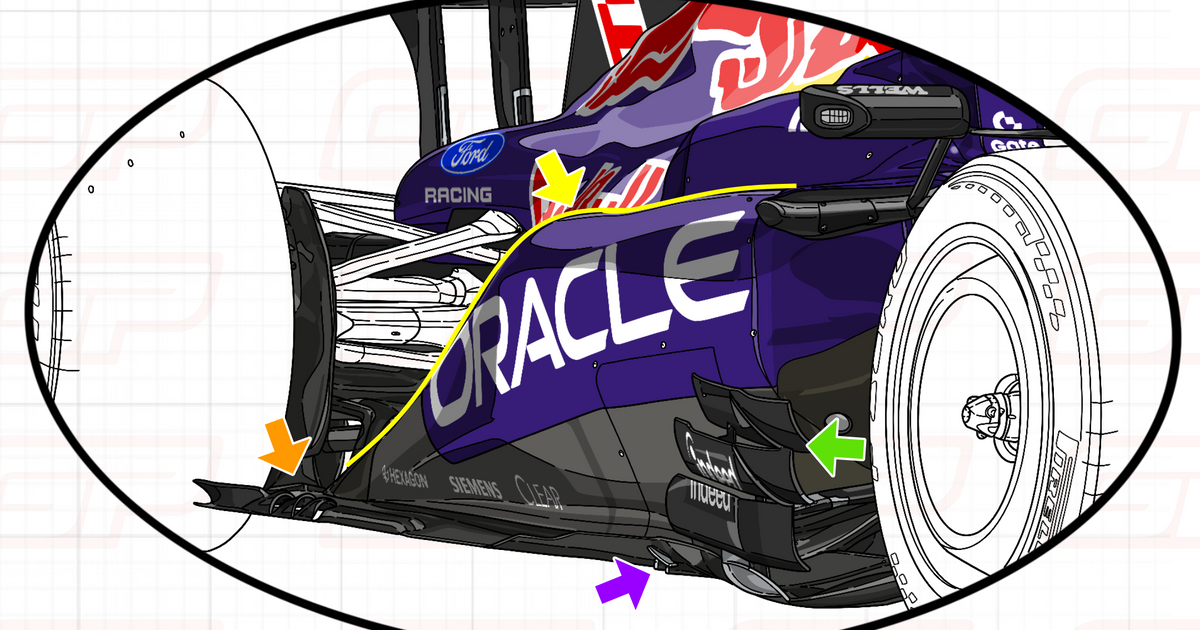
- Sidepod Redesign: The new sidepods feature a steeply sloping upper edge to aggressively channel airflow toward the diffuser and a large "mouse hole" alongside it. Internally, they were hollowed and lengthened to increase airflow to the rear, boosting downforce.
- Floor & Bargeboard Tweaks: Modifications to the floor's lateral fence and bargeboard help manage turbulence from the front tires. Vortex generators on the floor's front edge improve sealing, while micro-aerodynamic changes at the rear work in synergy with the front updates.
- Front Wing Addition: A new horizontal tray on the front wing endplate generates vortices that reduce drag and aid in sealing the floor edge, a solution now common across the grid.
- Innovative "Macarena" Rear Wing: The most striking change is a dual-flap rear wing that rotates 160 degrees counter-clockwise and lifts slightly in a straight-line mode. This clever design maximizes the gap for airflow, significantly reducing drag and contributing to the car's strong straight-line speed in Miami qualifying.
The results were tangible. Verstappen felt an immediate improvement in long-run simulations, nearly overtook George Russell in the Sprint race, and secured his best qualifying of the year. His 50-lap stint on hard tires during the race underscored the car's newfound consistency.
What's Next:
The true test for the revived RB22 will be confirming this performance on radically different circuits. The low-speed, high-downforce demands of the upcoming Monaco Grand Prix and the mixed challenge of Montreal will reveal if the Miami updates have created a universally more compliant car or a circuit-specific solution. If the performance translates, Red Bull has successfully stabilized its platform and can begin focusing on pure performance upgrades to close the gap to the very top.
Don't miss the next lap
Get the deep dives and technical analysis from the world of F1 delivered to your inbox twice a week.
Zero spam. Only high-octane analysis. Unsubscribe anytime.
Join the inner circle
Get the deep dives and technical analysis from the world of F1 delivered to your inbox twice a week.
Zero spam. Only high-octane analysis. Unsubscribe anytime.